

Ethyl Vanillin
Ethyl vanillin is an aromatic aldehyde with a stronger and sweeter vanilla scent. Its aroma intensity is significantly higher than that of vanillin. It can provide a rich and long-lasting vanilla sweetness at lower dosages and is widely used in fragrance systems that require high performance.
Type
Woody
The aroma is sweet and rich, with very distinct vanilla characteristics. It has a milky sweetness and a powdery base, and is thicker and more direct than vanillin, with stronger diffusion and longevity.
Acquisition Methods
Chemical synthesis
Ethyl vanillin does not exist naturally in vanilla beans. It is synthesized entirely through a multi-step reaction of substituted guaiacol derivatives to ensure stable aroma intensity, consistency, and large-scale supply capability.
Basic Information
| English Name | Ethyl Vanillin |
| Common Industry Name | Ethyl Vanillin |
| Chemical Category | Aromatic Aldehydes |
| Molecular Formula | C₉H₁₀O₃ |
| Molecular Weight | 166.17 g/mol |
| CAS Number | 121-32-4 |
| Appearance | White to pale yellow crystalline powder |
Technical Data
| Boiling point | 285 °C (decomposes) |
| Melting point | 76–78 °C |
| Flash point | 160 °C |
| Density (20 °C) | Approx. 1.11 g/cm³ |
| Solubility | Easily soluble in ethanol, low solubility in water, good compatibility with most essential oil systems |
| Stability | Superior thermal and storage stability compared to vanillin, suitable for high-temperature processing and long-cycle product applications. |
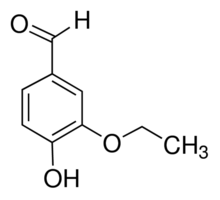
Chemical Structure
C₉H₁₀O₃
Fragrance Characteristics
| Fragrance Characteristics | Rich, sweet vanilla scent with prominent creamy and powdery notes; full-bodied and long-lasting. |
| Fragrance Family | Middle to Base |
| Common Pairings | Vanillin, Coumarin, Heliotropin, Cinnamyl Alcohol, Amber accords, Musk accords |
| Applications | Perfumes (sweet, oriental), daily chemical fragrances (baby care, cleaning, fabric care), home fragrances, candles, food flavorings (when compliant with food-grade regulations) |
Safety and Compliance
| IFRA Guidelines | Ethyl Vanillin is an ingredient permitted by IFRA, with relatively lenient restrictions, making it suitable for projects with high compliance requirements. |
| Stability | Regulations and industrial applications are mature, with high batch-to-batch consistency, suitable for large-scale continuous supply. |
| Allergy Risk | The risk of allergies is low, and it is generally not included in the EU’s mandatory list of high-risk sensitizing fragrances (subject to the latest regulations). |
Application Highlights
- The aroma intensity is approximately 3–4 times that of vanillin.
- Achieving the same or even stronger sweetness with lower dosages.
- Longer-lasting fragrance and better heat stability.
- Ideal for cost-sensitive or high-performance-oriented B2B projects.
Get in Touch
Interested in learning more about our products, solutions or our company? We are happy to support!