
What Is Myrrh And Its Role In Perfume?
Myrrh is one of perfumery’s oldest accomplices. Dark, resinous, and quietly commanding, it resists simplification. At a glance, myrrh is a natural aromatic resin, but in practice, it is a material layered with history, chemistry, and emotion.
Despite the industry’s obsession with innovation, myrrh has never fallen out of favor. Modern perfumery continues to rely on it for depth, gravitas, and olfactory architecture. It anchors compositions that might otherwise feel fleeting or hollow.
From temple rituals thick with smoke to sterile contemporary fragrance laboratories, myrrh has crossed millennia without losing relevance. Few materials can claim such continuity.
What Exactly Is Myrrh?
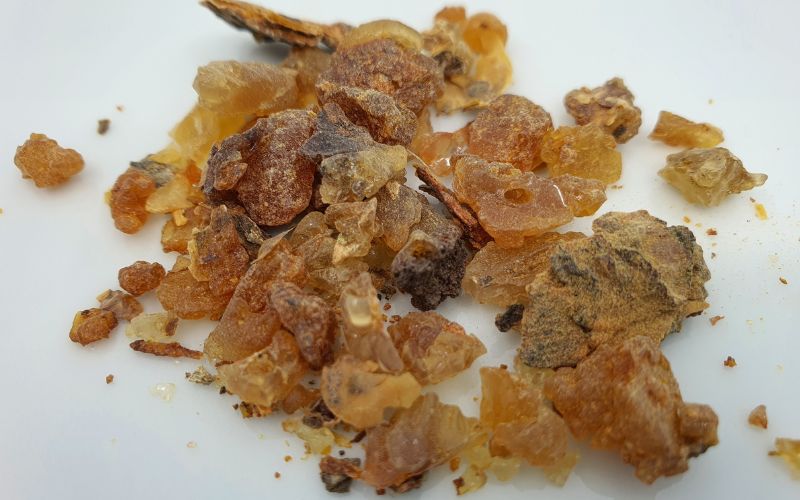
Myrrh is a natural resin exuded from trees belonging to the Commiphora genus. When the bark is cut, a viscous sap seeps out and hardens upon exposure to air, forming irregular amber-brown tears.
These trees thrive in arid and semi-arid regions, particularly in East Africa and the Arabian Peninsula. Harsh climates shape their chemistry, concentrating aromatic compounds as a form of botanical self-defense.
Harvesting myrrh is a slow, labor-intensive process. Incisions are made by hand. The resin is left to solidify naturally before being collected, cleaned, and graded. No shortcuts. No industrial haste.
In perfumery, myrrh appears in several forms. Raw myrrh resin is dense and smoky. Myrrh resinoid, extracted using solvents, offers a smoother and more manageable profile. Myrrh essential oil, produced via steam distillation, is lighter, sharper, and more volatile, often used to add lift rather than weight.
A Brief History of Myrrh in Human Civilization
Myrrh was already ancient when history began recording it. In Egypt, it was indispensable. Used in embalming, sacred incense, and early perfumed unguents, myrrh symbolized preservation and transcendence.
Mesopotamian cultures burned it as an offering to the divine. In ancient China, it was valued as both medicine and aromatic, believed to stimulate circulation and dispel stagnation.
Religious traditions elevated myrrh to near-mythical status. Sacred smoke filled temples, marking transitions between the physical and spiritual realms.
Beyond ritual, myrrh was commerce. It traveled along early trade routes as a high-value commodity, traded for gold and spices. In early perfumery, it functioned as both fragrance and fixative, shaping the earliest aromatic formulas long before modern chemistry existed.
The Olfactory Profile of Myrrh
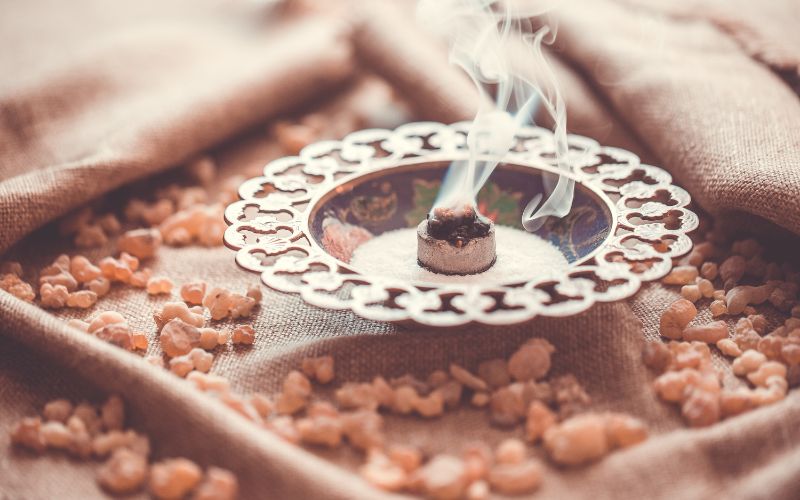
Describing myrrh requires restraint. It is resinous, yes, but also balsamic, bittersweet, and faintly medicinal. There is smoke, but not fire. There is sweetness, but never indulgence.
Perfumers describe myrrh using terms like ambery, earthy, leathery, and slightly astringent. It has a solemnity to it, an introspective tone that commands attention without demanding it.
On skin, myrrh unfolds slowly. The opening can feel sharp and mineralic. Over time, it softens, revealing warmth and a rounded, almost velvety dryness. In the dry-down, it lingers quietly, long after brighter notes have vanished.
This evolution is precisely why myrrh feels timeless. It does not chase trends. It waits.
The Chemistry Behind Myrrh’s Scent
Myrrh’s aromatic complexity is driven by a dense concentration of sesquiterpenes and furanosesquiterpenoids. These heavy molecules evaporate slowly, providing exceptional longevity.
Sesquiterpenes contribute depth, warmth, and structural weight. They are responsible for myrrh’s ability to ground volatile compositions and extend fragrance life.
Chemically, myrrh is stable. It resists rapid oxidation and degradation, making it a reliable base note. Its diffusion is moderate rather than explosive, favoring intimacy over projection.
As a fixative, myrrh enhances cohesion. It binds disparate notes together, smoothing transitions and reinforcing the overall architecture of a perfume.
Myrrh’s Role in Perfume Composition
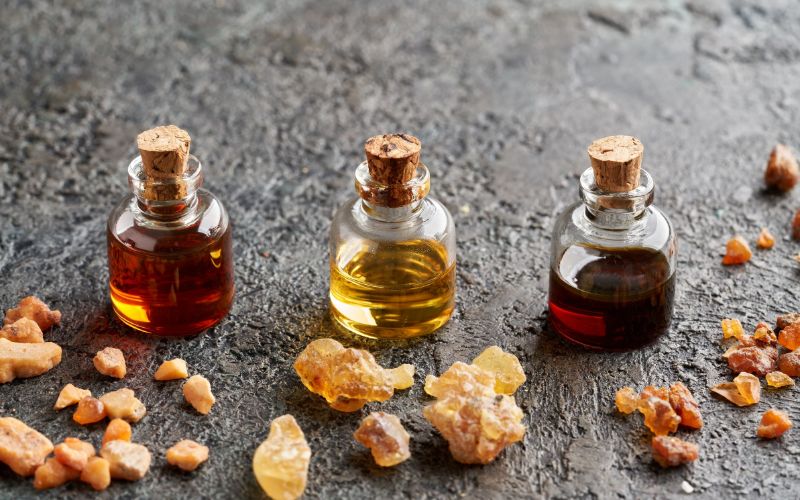
Perfumers choose myrrh for control. It is often placed in the base, sometimes the heart, rarely the top. Wherever it sits, it stabilizes.
In complex structures, myrrh acts as an anchor, preventing sweet notes from becoming cloying and smoky notes from turning abrasive. It introduces seriousness. Gravitas.
Emotionally, myrrh evokes calm, reflection, and depth. It slows the fragrance down. It asks the wearer to pay attention.
Perhaps most importantly, myrrh connects opposing elements. It bridges sweetness and spice, smoke and softness, austerity and comfort. Few materials perform this balancing act with such quiet authority.
Common Fragrance Pairings with Myrrh
Myrrh and incense are natural allies. Together, they create sacred, smoky accords reminiscent of ancient temples and still air.
With amber, vanilla, and balsamic notes, myrrh gains warmth and sensuality without losing restraint. The sweetness feels tempered, mature.
Spices like cinnamon, clove, and saffron amplify myrrh’s exoticism, adding heat and texture. These combinations feel opulent rather than aggressive.
Floral notes such as rose and jasmine introduce contrast. Their brightness lifts myrrh’s darkness, creating tension and intrigue.
Woody materials—sandalwood, cedar, patchouli—extend myrrh’s longevity and reinforce its earthy, grounded character.
Myrrh Across Different Perfume Styles
In oriental and ambery fragrances, myrrh is foundational. It provides depth and ritualistic warmth.
Niche and artisanal perfumery embrace myrrh for its narrative power. It signals seriousness, craftsmanship, and intent.
In minimalist and unisex compositions, myrrh offers quiet complexity without ornamental excess. It does not shout gender. It whispers mood.
Myrrh also thrives in solid perfumes and attars, where its resinous nature aligns naturally with concentrated, oil-based formats.
Natural vs. Synthetic Myrrh in Perfumery
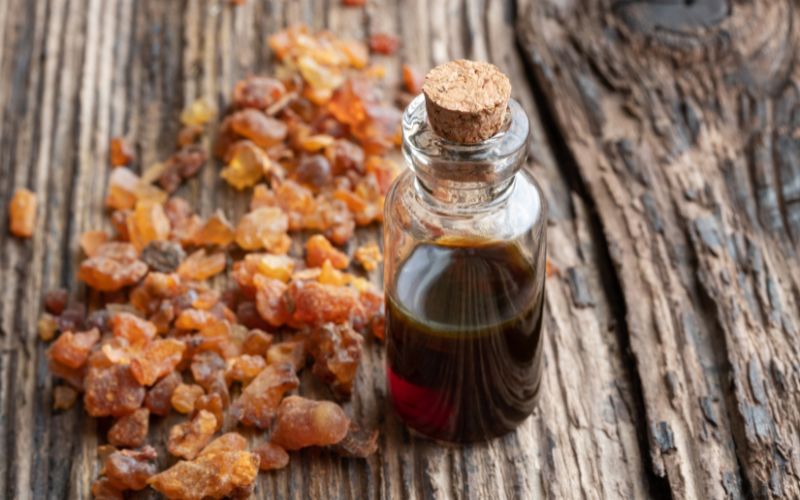
Natural myrrh is beautiful, but inconsistent. Variations in climate, harvest, and storage can alter aroma profiles significantly.
Modern perfumery often relies on reconstructed myrrh accords to achieve consistency. These accords replicate key facets of myrrh while allowing precision control.
Sustainability and cost also influence material selection. Synthetic components reduce pressure on natural resources and ensure scalable production.
Rather than replacing creativity, synthetics expand it. They allow perfumers to emphasize specific aspects of myrrh—smoke, sweetness, dryness—without compromise.
Cultural and Emotional Symbolism of Myrrh in Fragrance
Myrrh carries symbolic weight. It is associated with spirituality, introspection, and ritual.
Historically linked to healing and preservation, it conveys seriousness and luxury without ostentation. It feels intentional.
Emotionally, myrrh creates space. It encourages stillness and contemplation. It resonates with wearers drawn to depth rather than spectacle.
This is why myrrh often appeals to mature, contemplative scent profiles—those seeking meaning, not novelty.
Myrrh in Contemporary Perfume Trends
Resinous notes are resurging, driven by a desire for authenticity and sensory grounding. Myrrh stands at the center of this movement.
Gender-neutral and niche fragrances increasingly rely on myrrh to transcend traditional categories. It belongs to no one and everyone.
In slow perfumery and storytelling scents, myrrh provides narrative continuity. It suggests time, memory, and permanence.
Market demand reflects this shift. Incense-inspired compositions are no longer fringe. They are firmly back in focus.
Evaluating Myrrh as a Fragrance Ingredient
Perfumers assess myrrh by aroma clarity, resin purity, and balance between bitterness and warmth. Inferior materials smell muddy. Quality myrrh breathes.
Buyers evaluate sourcing, consistency, and traceability. In B2B contexts, reliability matters as much as aroma.
Regulatory and safety considerations also shape usage levels, particularly in fine fragrance versus functional applications.
Performance varies across concentrations. In parfum, myrrh dominates. In eau de toilette, it supports. In every format, it stabilizes.
Myrrh Remains Irreplaceable in Perfume
Myrrh endures because it performs. It carries history, delivers chemistry, and evokes emotion in equal measure.
It balances ancient tradition with modern formulation needs. Few materials can claim such versatility.
Perfumers continue to return to myrrh not out of nostalgia, but necessity. It does what few others can.
At Scentake, this philosophy guides material selection and fragrance development. Deep respect for raw materials. Precise execution. No compromises.
If you are seeking high-quality fragrance ingredients or customized scent solutions that honor both tradition and innovation, contact Scentake today. Let meaningful fragrance begin at the source.