

What Is The 305020 Rule For Perfume?
In perfumery, structure is invisible—but it governs everything.
Behind every balanced fragrance lies a quiet arithmetic, one that determines how a scent opens, evolves, and ultimately stays in memory. The 30·50·20 rule is one of the most widely referenced frameworks for understanding this architecture.
It is not a rigid formula.
It is a guiding logic.
For the general public, understanding this rule clarifies why certain perfumes feel harmonious while others collapse into chaos.
Understanding the 30·50·20 Rule
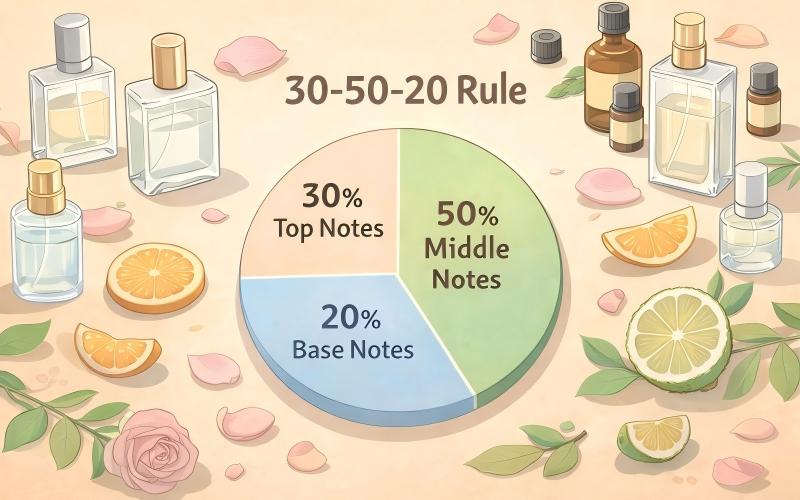
The 30·50·20 rule refers to the proportional distribution of perfume notes across a fragrance’s lifecycle:
30% Top Notes
50% Heart (Middle) Notes
20% Base Notes
These percentages do not describe concentration levels like Eau de Parfum or Eau de Toilette.
Instead, they describe olfactory emphasis—how much each layer contributes to the overall perception of the scent over time.
This framework is commonly referenced in perfumery education, formulation training, and internal brand development guidelines, particularly in fine fragrance and functional fragrance design.
Why Top Notes Typically Occupy 30%
Top notes are the first impression.
They are volatile, ephemeral, and fast-moving.
Citrus oils, light aromatics, aldehydes, and green facets dominate this layer. According to IFRA-related volatility studies, many top-note materials evaporate within 15 to 30 minutes after application.
Why allocate roughly 30%?
Because top notes must:
Capture attention instantly
Communicate freshness or identity
Evaporate cleanly without lingering distortion
Too little, and the perfume feels muted at first contact.
Too much, and it collapses once those materials burn off.
In commercial terms, top notes drive consumer trial, not long-term loyalty.
The 50% Heart: Where Identity Truly Lives
The heart notes are the structural core of a fragrance.
They define character, style, and emotional direction.
Florals, spices, fruits, and soft aromatics dominate this stage. These materials are less volatile, often emerging after the top notes fade and remaining present for several hours.
Industry formulation data suggests that consumers form their final judgment of a fragrance within the first 1–3 hours of wear. That time window is almost entirely governed by the heart.
This explains the 50% allocation.
The heart must:
Bridge freshness and depth
Maintain coherence across skin chemistry
Represent the brand’s olfactory signature
From a market perspective, this is where market positioning happens.
Why Base Notes Are Often Limited to 20%
Base notes anchor the fragrance.
They persist.
Woods, resins, musks, ambers, and balsamic materials define this layer. Some synthetic musks and woody molecules can remain detectable for 12 hours or more, even at low dosages.
Why only 20%?
Because base notes are powerful.
They shape longevity disproportionally to their volume.
Excessive base-heavy construction often results in:
Olfactory fatigue
Reduced versatility
Lower acceptability in mass or cross-cultural markets
Well-calibrated base notes create quiet persistence, not dominance.
How the 30·50·20 Rule Applies in Commercial Fragrance Development
For sellers, the value of this rule lies in predictability.
It helps brands:
Evaluate fragrance balance during sampling
Communicate expectations with manufacturers
Adjust formulas for different climates and usage scenarios
For example:
Hot climates often require lighter top-to-heart transitions
Personal care products may reduce top notes due to rinse-off loss
Home fragrances often invert the rule to emphasize base diffusion
The rule adapts. The logic remains.
Common Misconceptions About the 30·50·20 Rule
This rule does not:
Guarantee longevity
Dictate raw material cost
Replace creative perfumery
Longevity depends on molecular weight, fixation, and skin interaction.
Cost depends on ingredient sourcing and compliance.
Creativity still decides how those percentages are expressed.
The rule is a structural compass, not a creative cage.
Why the Rule Still Matters in Modern Perfumery
Despite innovations like captive molecules and AI-assisted formulation, the human nose still perceives fragrance sequentially.
That perception has not changed.
The 30·50·20 rule endures because it reflects how scent is perceived by the senses, how fragrances are actually worn, and how they can be reliably produced at scale.
Most best-selling global fragrances—across fine fragrance, personal care, and lifestyle categories—still unconsciously respect this balance.
From Theory to Execution: Where Expertise Matters
Understanding structure is one thing.
Executing it consistently is another.
At Scentake, fragrance development is guided by structural clarity, regulatory awareness, and real-world market performance. Whether creating fine fragrances, personal care scents, or functional fragrance systems, balance is treated as a technical discipline—not guesswork.
Contact Scentake to discuss fragrance solutions designed for balance, scalability, and global markets.
Let structure work quietly—while your brand speaks clearly.