

Ambroxan
Ambroxan is a high-impact amber–woody aroma chemical renowned for its exceptional fixative power, diffusion, and longevity. Originally developed as a sustainable alternative to natural ambergris, Ambroxan has become a cornerstone molecule in modern fine fragrance and functional perfumery.
Type
Woody / Amber
Ambroxan delivers a clean, warm, mineral-amber woody profile with subtle musky and balsamic undertones. It enhances depth without heaviness and provides a modern, elegant backbone to fragrance compositions.
Acquisition Methods
Chemical synthesis
Ambroxol is typically synthesized via oxidation and cyclization reactions of sarcopentyl alcohol or synthetic intermediates, historically derived from natural sclareol (from clary sage), though modern industrial production increasingly relies on fully synthetic routes to ensure cost stability, consistency, and scalability.
Basic Information
| English Name | Ambroxan |
| Common Industry Names | Ambroxide, Ambrox |
| Chemical Class | Ambergris-type terpenoid |
| Molecular Formula | C₁₆H₂₈O |
| Molecular Weight | 236.39 g/mol |
| CAS Number | 6790-58-5 |
| Appearance | White to off-white crystalline solid |
Technical Data
| Boiling Point | > 300 °C (decomposes) |
| Melting Point | 75–78 °C |
| Flash Point | > 100 °C |
| Density (20 °C) | ~1.02 g/cm³ |
| Solubility | Insoluble in water; soluble in alcohols and fragrance solvents |
| Stability | Excellent thermal, oxidative, and formulation stability |
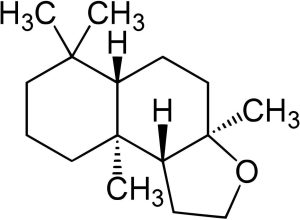
Chemical Structure
Fragrance Characteristics
| Odor Description | Amber, woody, dry, slightly musky, mineral |
| Note Position | Base note |
| Common Pairings | Citrus (bergamot, grapefruit), Floral musks (hedione, muguet bases), Woods (Iso E Super, Cedramber, Sandalwood molecules) |
| Application Areas | Fine fragrance (EDT, EDP, extrait), Functional fragrances (detergents, fabric care), Personal care (shampoos, body washes) |
Safety and Compliance
| IFRA Status | Approved for use under IFRA guidelines |
| Formulation Stability | Highly stable across pH ranges and product matrices |
| Allergen Risk | Low sensitization risk; widely accepted in global formulations |
Application Highlights
- Exceptional Fixative Efficiency: Extends fragrance longevity without increasing dosage
- Cost-to-Performance Advantage: Replaces animal-derived ambergris at industrial scale
- Formulation Flexibility: Compatible with both fine fragrance and functional bases
- Market-Proven Molecule: Recognizable “modern luxury” signature in global bestsellers
- Regulatory-Friendly: Long-term compliance security across major markets
Get in Touch
More Ingredients

Ambroxan
Ambroxan Ambroxan is a high-impact amber–woody aroma chemical renowned for its exceptional fixative power, diffusion, and longevity. Originally developed as a sustainable alternative to natural

Iso E Super
Iso E Super Iso E Super is a synthetic fragrance ingredient with a soft woody, amber-like quality and velvety sillage. While its scent is understated,
Isoamyl Acetate
Isoamyl Acetate Isoamyl acetate is an ester aroma component with a distinct banana and tropical fruit scent. Its aroma is lively and diffuses quickly, making

Angelica Lactone α
Angelica Lactone α Angelica Lactone α is a lactone aroma compound with warm, creamy, slightly caramel and root notes, often used to enhance the naturalness,

Ethyl Vanillin
Ethyl Vanillin Ethyl vanillin is an aromatic aldehyde with a stronger and sweeter vanilla scent. Its aroma intensity is significantly higher than that of vanillin.

Vanillin
Vanillin Vanillin is an aromatic aldehyde with a sweet, soft, and typical vanilla scent. It is one of the most basic and crucial structural ingredients

Coumarin
Coumarin Coumarin is a lactone aroma compound with warm, sweet, hay- and almond-like notes. It is a key structural ingredient in classic oriental, fougère, and

Cinnamaldehyde
Cinnamaldehyde Cinnamaldehyde is an aromatic aldehyde with a warm, spicy, and sweet cinnamon scent. It is an indispensable core ingredient in oriental, spicy, and festive
Cinnamyl Alcohol
Cinnamyl Alcohol Cinnamyl alcohol is an aromatic alcohol with a warm, slightly sweet, and floral cinnamon-like scent. Its aroma is milder and less pungent than

Citral
Citral Citral is a linear aldehyde aroma component with a strong, fresh lemon scent. Its aroma is bright, clean, and highly sillage, making it a

Indole
Indole Indole is a nitrogen-containing heterocyclic aromatic compound, originally discovered in indigo dye, and naturally found in various plants (such as jasmine and orange blossom)

Methyl Anthranilate
Methyl Anthranilate Methyl anthranilate is a classic fragrance molecule that combines natural notes with precise laboratory synthesis. It is naturally found in orange blossom, grape,