

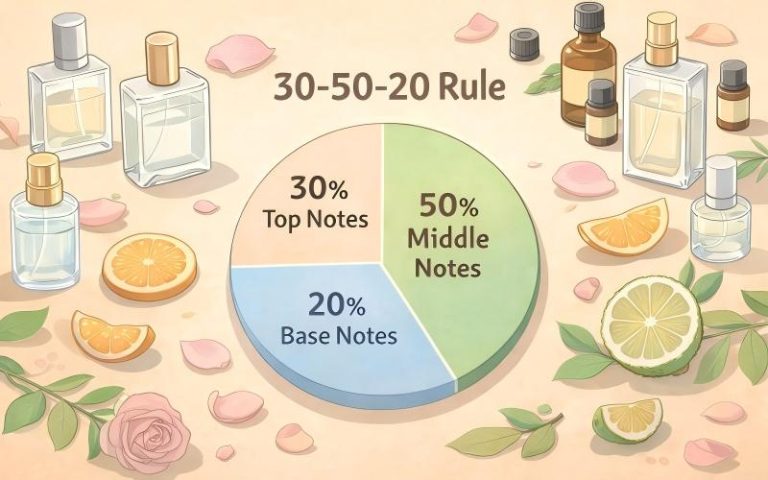
What Is The 305020 Rule For Perfume?
In perfumery, structure is invisible—but it governs everything.Behind every balanced fragrance lies a quiet arithmetic, one that determines how a scent opens, evolves, and ultimately stays in memory. The 30·50·20 rule is one of the most widely referenced frameworks for understanding this architecture. It is not a rigid formula.It is a guiding logic. For the general public, understanding this rule clarifies why certain perfumes feel harmonious while others collapse into chaos. Understanding the 30·50·20 Rule The 30·50·20 rule refers to the proportional distribution of perfume notes across a fragrance’s lifecycle: 30% Top Notes 50% Heart (Middle) Notes 20% Base Notes These percentages do…

What Are The 4 Main Scents?
In the fragrance industry, complexity sells—but clarity converts.Behind thousands of perfumes and countless olfactory descriptions, there is a surprisingly stable structure that guides how scents are categorized, formulated, and commercialized. Most professional perfumers and fragrance houses broadly group scents into four main scent families.These families are not rigid boxes. They are functional frameworks.And for brands, importers, and private-label buyers, understanding them is a practical advantage rather than a theoretical exercise. Why Scent Classification Matters in the Global Fragrance Market From a commercial standpoint, scent families serve three purposes: They simplify communication between formulators, buyers, and marketers. They help predict consumer…

Which Perfume Note Is The Strongest And The Most Attractive?
In perfumery, strength and attraction are not accidental outcomes.They are engineered through chemistry, olfactory psychology, and market intent. Understanding “Strength” and “Attractiveness” in Perfume Notes Before naming specific notes, it is essential to define the metrics. What Makes a Perfume Note “Strong”? Strength in perfumery typically refers to: Longevity: how long a note remains perceptible on skin or fabric Projection (sillage): how far the scent radiates Substantivity: molecular persistence over time These qualities are largely dictated by molecular weight and volatility. Heavier molecules evaporate slowly. Lighter ones vanish quickly. What Makes a Note “Attractive”? Attractiveness is more nuanced.It is shaped…

Natural vs Synthetic Fragrance Ingredients: What’s the Real Difference?
In the fragrance industry, few debates are as persistent—or as commercially misunderstood—as the one between natural and synthetic fragrance ingredients.The conversation is often emotional. Sometimes ideological. Rarely technical. This distinction is not about romance. It is about performance, compliance, scalability, and cost control. What “Natural” and “Synthetic” Really Mean In perfumery, “natural” typically refers to aromatic materials derived directly from botanical or animal sources through processes such as steam distillation, solvent extraction, or cold pressing. Examples include lavender oil, sandalwood oil, rose absolute, and citrus essences. “Synthetic,” by contrast, describes aroma molecules created through chemical synthesis—either replicating compounds found in nature or producing…

Is Lilial banned in perfume?
In the global fragrance industry, regulatory compliance is as critical as scent creativity. One topic that has generated considerable attention among perfumers, formulators, and procurement professionals is Lilial—an aroma chemical long used to impart floral, clean, and powdery facets in perfumes and scented products. But what is its regulatory status today, and what does that mean for product development and market access? What Is Lilial? Lilial (chemical name: butylphenyl methylpropional or BMHCA) was historically used for its pleasant lily-of-the-valley-like scent. It was popular in fine fragrances, personal care products, household scents, and laundry fragrances because of its fresh, floral quality. Chemically,…

Understanding Eau de Cologne, Eau de Toilette & Eau de Parfum
In the fragrance industry, terms like Eau de Cologne (EDC), Eau de Toilette (EDT), and Eau de Parfum (EDP) are often treated as simple indicators of strength. In reality, they represent distinct product strategies, influencing formulation design, cost structure, performance expectations, and market positioning. What Do These Terms Actually Mean? At a technical level, EDC, EDT, and EDP primarily differ in fragrance oil concentration, but concentration alone does not tell the whole story. Industry-standard ranges are generally understood as: Eau de Cologne (EDC): ~2–4% fragrance oil Eau de Toilette (EDT): ~5–15% fragrance oil Eau de Parfum (EDP): ~15–20% fragrance oil These ranges provide a…

What Is Oud (Oudh) Fragrance And Why Is It So Expensive?
Few fragrance materials command as much intrigue, prestige, and price as oud—also known as oudh or agarwood. Revered for centuries in the Middle East and Asia, oud has become one of the most sought-after ingredients in modern perfumery. For those in the fragrance industry, the question is no longer what oud is, but why it costs so much and how it can be used commercially without compromising quality or scalability. What Exactly Is Oud? Oud is a resinous material formed inside the heartwood of Aquilaria trees when they become infected by specific molds. In response, the tree produces a dark, aromatic resin as…

What Makes a Perfume Long-Lasting?
Longevity is one of the most frequently asked—and least clearly understood—attributes in perfumery. For consumers, a long-lasting perfume means value and satisfaction. For brands, manufacturers, and buyers, longevity is a technical outcome shaped by formulation strategy, ingredient selection, and product design. Perfume Longevity: More Than Just Concentration A common misconception is that higher fragrance concentration automatically equals longer wear. While concentration matters, it is only one variable. For example: Eau de Parfum (EDP) typically contains 15–20% fragrance oil Eau de Toilette (EDT) usually ranges from 8–12% However, two perfumes at the same concentration can perform very differently. Longevity is the…
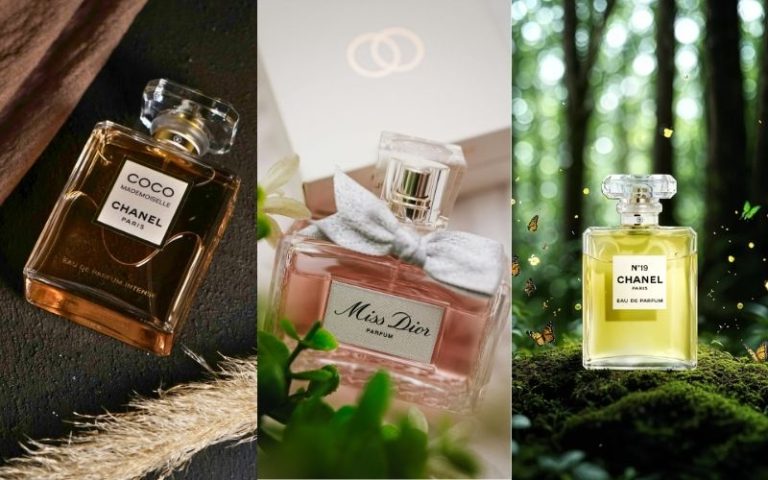
Everything You Need To Know About Chypre Fragrances
Among the many fragrance families in perfumery, Chypre occupies a distinctive and influential position. It is not defined by a single scent, but by a structural formula—one that has shaped fine fragrance creation for more than a century and continues to inform modern perfumery today. For fragrance brands, formulators, and buyers, understanding Chypre fragrances is less about nostalgia and more about how classical structures are adapted to meet contemporary market, regulatory, and commercial demands. What Is a Chypre Fragrance? The term Chypre (pronounced sheep-rah) originates from the French word for Cyprus. In perfumery, it refers to a fragrance structure popularized in the…