


Can You Make a Weak Perfume Stronger? What Works and What Doesn’t
A stronger perfume is not always a better formula A perfume can feel weak for several reasons. Perhaps the opening disappears quickly. Perhaps it stays close to the skin. Perhaps its drydown is present but quieter than expected. Or perhaps the wearer has simply become accustomed to it. Adding more fragrance oil can change the result, yet it is only one lever. A well-built perfume has to balance recognisable character, diffusion, substantivity, stability, comfort, and the limits that apply to its intended use. Key takeaway: You can make a perfume feel stronger by improving formula architecture, concentration, and application fit.…
How Much Fragrance Oil Should You Use in Candles, Soap and Diffusers
Start with the product, not a percentage A candle maker, soap maker, and diffuser brand can all ask for “the right fragrance oil load” and receive three different useful answers. The carrier changes the job. Wax has to release aroma through a melt pool. Soap has to survive mixing, curing, and rinsing. A reed diffuser needs controlled evaporation through a base and reed system. A number copied from another product is only a starting point, never a finished formula. The better question is: what loading range has been assessed for this specific fragrance, this specific base, and this intended market?…

How to Choose Perfume for Sensitive Noses Without Giving Up Scent
Start with the trigger, not the perfume family For someone with a sensitive nose, choosing perfume can feel like a trade between personality and comfort. A bright citrus that feels cheerful in a shop may become sharp in a warm car. A soft musk may be pleasant on a blotter, then feel heavy after an hour. The useful question is not simply which note is “gentle.” It is which exposure, format, concentration, and wearing routine lets you enjoy scent without inviting the reaction you already know too well. Sensitive noses are not all sensitive in the same way. One person…

What Does “Natural Fragrance” Mean on a Product Label?
A Front-Label Phrase Is the Beginning of the Definition Natural fragrance appears on perfume, skincare, soap, home fragrance, and cleaning-product packaging. It can signal that the scent is made from plant, mineral, microbial, or naturally derived inputs under a framework. The two words do not reveal the formula, percentage, processing rules, certification, allergens, or performance. Core answer: natural fragrance is usually a sourcing and formulation claim defined by a brand, supplier, standard, certification program, or market convention. Its meaning can vary. Read the nearby qualifier, ingredient list, certification mark, website definition, and supporting documents together. Natural origin does not automatically…

Essential Oils vs Fragrance Oils: Differences in Scent, Safety, Cost and Stability
The Names Describe Material Strategies, Not Quality Grades Essential oil and fragrance oil are often presented as opposing quality labels. In product development, they describe different material strategies. An essential oil is a volatile plant extract, commonly obtained by distillation or expression. A fragrance oil is a formulated aromatic mixture designed to deliver a chosen scent and performance target. It may contain essential oils, other natural extracts, aroma molecules, solvents, and functional ingredients. Core answer: essential oils offer recognizable botanical character and natural-source storytelling. Fragrance oils offer a wider scent palette and greater control over strength, consistency, cost, and product…
Why Fragrance Oils Discolor Soap: Vanillin, Bases and Testing Methods
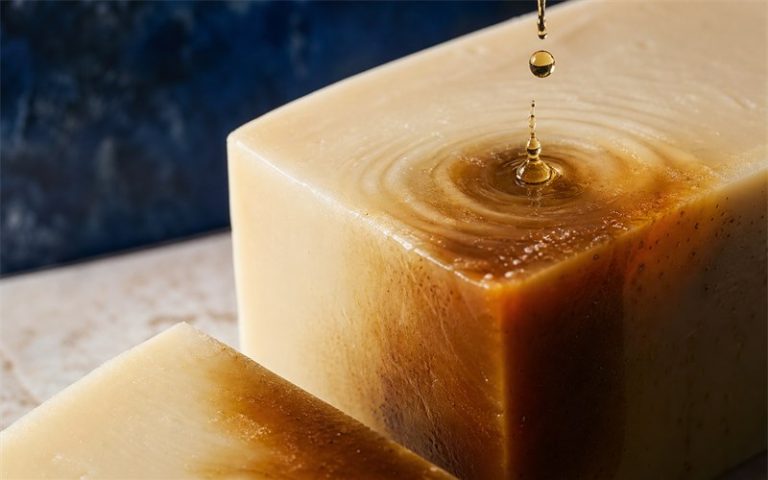
The Color Change Often Starts After the Soap Looks Finished A freshly poured soap can look cream, pink, or bright blue, then move toward tan or deep brown during the next several days. The fragrance may smell exactly as expected. The visual shift still matters because it can obscure a swirl, alter a label claim, or make production batches appear inconsistent. Core answer: fragrance oils often discolor soap because vanillin and certain other aroma materials develop color through reactions encouraged by air, alkalinity, heat, and time. The final shade depends on the fragrance dosage, the complete fragrance composition, the soap…

Why Does a Perfume Label Say “Fragrance” Instead of Listing Every Ingredient?
One Word Can Represent a Complex Mixture Turn over a perfume box and the ingredient line may name alcohol, water, colorants, and then a single word: “Fragrance.” That compact entry can represent a composed scent mixture containing numerous odor materials and supporting ingredients. The label is using a collective declaration permitted by the rules of the market, rather than claiming that the bottle contains only one aromatic substance. Core answer: in the United States, a cosmetic fragrance compound may be declared as “Fragrance” under 21 CFR 701.3. The term groups the materials used to create the scent while protecting commercially…

What Is an IFRA Certificate and Why Does It Matter for Fragrance Products?
A Certificate Can Look Complete and Still Be Misused A fragrance supplier sends a one-page certificate showing several product categories and percentages. The buyer selects the largest number, adds the fragrance at that level, and marks the finished product “IFRA certified.” Each step creates a different problem. The category may be wrong, the percentage may be an upper compliance limit rather than a sensible formula target, and IFRA did not certify the product. The document buyers usually call an IFRA certificate is more accurately a Certificate of Conformity to the IFRA Standards. It connects one identified fragrance mixture with specified…

Fragrance Oil Flash Point Explained: What It Means for Candles, Soap and Shipping
The Number on the SDS Is Easy to Misread A candle maker sees a fragrance oil flash point of 66°C and plans to add the oil to wax at 82°C. A soap maker sees the same number and worries that the scent will vanish during processing. A logistics team sees it and wants to know whether the carton can travel by air. These are three different decisions, and the flash point answers only part of one of them. Flash point describes an ignition condition measured by a defined laboratory method. It helps classify physical fire hazards and can affect storage…