
What Is a Fragrance Formula and Why It Matters
Most people choose a perfume in seconds.
A quick spray. A first impression. A decision.
Yet what you smell in that moment is only the surface of something far more intricate. Behind every fragrance lies a formula—carefully constructed, precisely balanced, and quietly responsible for everything you experience: the opening brightness, the lingering warmth, even how the scent behaves on your skin hours later.
You may never see it.
But it shapes everything.
Understanding what a fragrance formula is, and why it matters, changes how you choose perfume. It also explains why some scents feel extraordinary, while others fade into forgettable background noise.
What Is a Fragrance Formula?
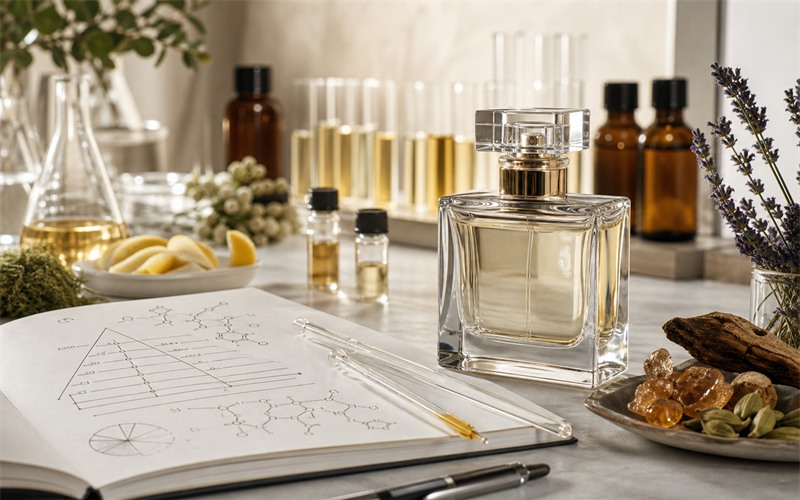
A fragrance formula is the blueprint of a perfume. It defines the exact composition of aromatic materials used to create a scent, including natural extracts, synthetic molecules, and functional ingredients such as solvents or stabilizers.
It is precise.
It is intentional.
Each formula specifies the percentage of every component, often measured down to fractions of a gram. Perfumers, sometimes referred to as “noses,” design these formulas to achieve a specific olfactory profile, performance, and emotional effect.
A finished perfume is not a random blend of pleasant smells. It is a controlled architecture.
Think of it as a composition rather than a mixture.
Every note has a role.
Why the Formula Matters More Than You Think
From a consumer’s perspective, the formula determines three critical aspects of a fragrance:
1. How the Perfume Smells Over Time
Perfume evolves in stages. The top notes appear first, often fresh and volatile. The heart notes define the character. The base notes provide depth and longevity.
This evolution is not accidental.
It is engineered.
According to fragrance education resources such as The Perfume Society, a scent can change significantly within the first 20–30 minutes as the top notes evaporate and the heart begins to emerge. That transformation is entirely driven by the formula.
A well-crafted formula creates a smooth transition between these stages.
A weaker one feels fragmented.
You may not consciously analyze it.
You will feel it.
2. How Long the Fragrance Lasts
Longevity is one of the most common concerns among consumers.
Why does one perfume last all day, while another disappears before lunch?
The answer lies largely in the formula. Ingredients with heavier molecular structures, such as woods, resins, and musks, evaporate more slowly and remain on the skin longer. Lighter molecules, like citrus, dissipate quickly.
A balanced formula uses both.
Industry discussions often highlight that concentration alone does not determine performance. Two fragrances with similar concentrations can behave very differently depending on how the formula is structured.
Longevity is not just about strength.
It is about composition.
3. How the Perfume Feels on Your Skin
This is where things become more personal.
Skin chemistry interacts with fragrance formulas in subtle yet meaningful ways. Factors such as skin pH, hydration, and temperature can influence how a scent develops.
That is why a perfume that smells elegant on someone else may feel completely different on you.
The formula sets the foundation.
Your skin completes the story.
This interaction explains why testing perfume on skin, rather than only on paper, is consistently recommended by fragrance experts and retailers.
Natural vs Synthetic: A Misunderstood Balance
Many consumers assume that natural ingredients are inherently superior. The reality is more nuanced.
Natural materials, such as essential oils or plant extracts, bring richness and complexity. They also vary depending on harvest conditions, climate, and sourcing.
Synthetic molecules, on the other hand, provide consistency, stability, and access to scent profiles that may not exist in nature. They are also essential for meeting safety standards and ensuring sustainable production.
The modern fragrance formula relies on both.
The International Fragrance Association (IFRA), a global authority on fragrance safety, emphasizes that fragrance ingredients—whether natural or synthetic—must comply with rigorous safety standards based on scientific research and risk assessment.
Quality does not come from origin alone.
It comes from how the formula is built.
Why Some Perfumes Smell “Expensive”
Consumers often describe certain perfumes as smelling “luxurious” or “high-end,” even without knowing why.
The answer is rarely a single ingredient.
It is the formula’s refinement.
A premium fragrance formula typically features:
- Smooth transitions between notes
- Balanced intensity without harsh edges
- Depth in the base notes
- Clarity in the opening
- Cohesion from start to finish
These qualities require expertise, time, and careful material selection. They also require restraint.
An overloaded formula can feel heavy or chaotic.
A refined one feels effortless.
That difference is subtle.
It is also unmistakable.
The Hidden Role of Stability and Safety
A fragrance formula is not only about scent. It must also perform reliably over time.
Perfumes need to remain stable under different conditions: heat, light exposure, storage duration, and transportation. Without proper formulation, a fragrance may degrade, discolor, or lose its intended profile.
Safety is equally important.
IFRA standards are widely recognized as the global benchmark for fragrance safety, ensuring that ingredients are used within safe limits and that consumer exposure is carefully evaluated.
For consumers, this means peace of mind.
For brands, it means credibility.
A beautiful scent without stability or compliance is a short-term success at best.
What Consumers Should Look for in a Well-Made Perfume
You do not need to read a formula sheet to recognize quality. You can observe it through experience.
Here are a few practical indicators:
- The fragrance evolves smoothly rather than abruptly
- The scent remains pleasant over time without turning sharp or flat
- The projection feels controlled, not overwhelming
- The dry-down retains character instead of fading into neutrality
- The overall impression feels coherent
Trust your perception.
It is more accurate than you think.
Final Thoughts
A fragrance formula is the invisible framework behind every perfume you wear. It defines how a scent begins, how it evolves, how long it lasts, and how it feels on your skin.
You may never see the formula.
You experience it every time you wear a fragrance.
Understanding this changes everything. It turns perfume from a casual purchase into a more deliberate selection. It also reveals why certain scents stay with you, while others quietly disappear.
In the end, the formula is where artistry meets precision.
And that is where good perfume becomes memorable.
About Scentake – Turning Fragrance Ideas into Reality
At Scentake, we understand that a great perfume starts with a well-crafted formula. Our team combines technical expertise, creative formulation, and market insight to develop fragrances that are both distinctive and commercially viable.
We work closely with brands, distributors, and private label clients to create customized perfume solutions—from concept development to final production.
Every formula is designed with intention.
Every scent is built to perform.
Looking to create your own fragrance line or source high-quality perfumes?
Contact Scentake today to discuss your project, request samples, or explore tailored fragrance solutions for your market.
Let’s create something worth remembering.