

Why Fragrance Oils Accelerate, Rice or Seize in Cold Process Soap
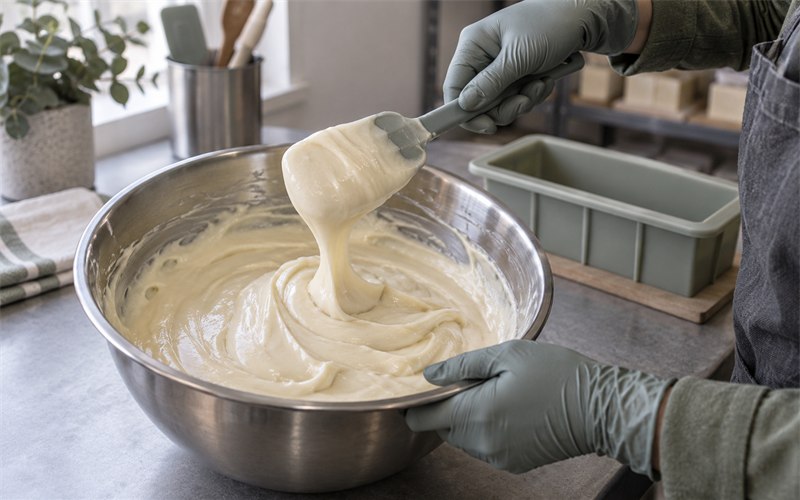
You add the fragrance, stir, and suddenly the soap batter leaves a deep groove instead of a smooth ribbon. Sometimes there are grains; sometimes the entire bowl becomes too stiff to pour. The timing makes the fragrance an obvious suspect. Understanding the change takes a closer look.
Fragrance-associated acceleration, ricing and seizing describe different changes in a particular soap base: faster bulk thickening, small lumps, and extreme loss of flow. Published supplier accounts point to interactions between the fragrance and base, but the sources reviewed here do not establish one chemical mechanism that explains every blend and symptom. Cooling hard fats can also mimic the trouble, even before fragrance is added.
That distinction gives you a useful starting point. Work out whether you are seeing thickening, grains or separation, note when it began, then compare the exact fragrance in a matched trial. A successful pour tells you about application fit. Explaining the molecular cause requires different evidence.
Why the batter changes after fragrance addition
Cold process soap is still developing when fragrance enters the bowl. OpenStax’s explanation of soap chemistry describes fats reacting with alkali to produce soap salts and glycerol. Soap molecules have water-attracting and oil-attracting parts. This establishes the chemistry of the base; it does not identify what a particular fragrance does to its reaction rate.
When batter thickens, the visible result can accompany chemical reaction or a physical change such as fat solidification. Those routes matter because the same stirring resistance does not identify the same cause. A flow observation cannot, by itself, show that the fragrance accelerated saponification. You would need measurements designed to separate reaction progress from changes in physical structure.
For ricing, the public explanations are more specific, yet remain supplier accounts. Bramble Berry attributes the grains to fragrance ingredients interacting with harder components of the oil blend. Wholesale Supplies Plus describes ricing as uneven saponification. These pages offer useful application guidance without directly measuring the proposed molecular pathway.
The practical implication is to test the fragrance and recipe together. The sources support observations of difficult handling and possible explanations; they do not let you blame a particular aroma chemical from the scent name alone. Keep ingredient-specific claims out of the diagnosis unless the supplier can substantiate them for the blend you are using.
Separate the visible states before choosing a response
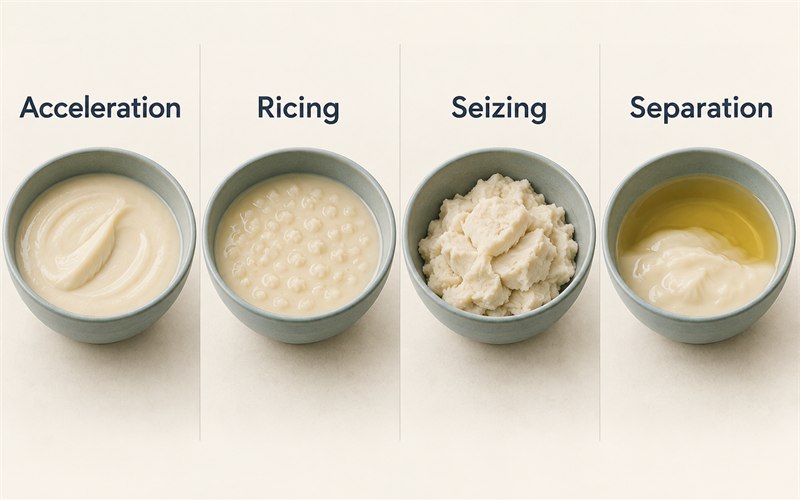
Acceleration and seizing concern the loss of working flow; ricing concerns texture. Bramble Berry describes seizing as an extreme form of acceleration and distinguishes separation by visible pooling. These observations can overlap. A grainy batch may still pour, while a smooth batch can become immovable.
| State | What you can observe | What to check next |
|---|---|---|
| Acceleration | Bulk thickening reduces the available pouring time. | Onset, mixing history and a matched unscented trial. |
| Ricing | Small grains or lumps develop in the mixture. | Whether the batter is still fluid and whether cooling preceded the grains. |
| Seizing | The mixture becomes extremely stiff before the planned pour. | The earlier thickening pattern and whether controlled handling remains possible. |
| Separation | Liquid or oil-rich areas pool apart from the mixture. | Emulsification, formulation and the process record. |
Use these names to describe the sample you observed. A photograph and an onset note are more helpful to a supplier than a report that simply says the fragrance “failed.”
Cooling explains one important look-alike
A known physical explanation deserves attention before you change the fragrance. In Soap Queen’s false-trace demonstration, hard fats resolidify as the mixture cools, before full emulsification. The batter appears thick or grainy even though that appearance does not establish how far saponification has progressed.
This is why “always soap cooler” can lead you in the wrong direction. If the change starts as cool lye solution meets the oils, before fragrance addition, that fragrance addition cannot explain the earlier onset. Check whether the hard fats were fully melted and stayed workable through mixing. Record oil and lye-solution temperatures separately.
The demonstration supports a cooling-related explanation in a hard-fat recipe. It does not give every base a single ideal temperature. Use a range evaluated for your formulation and ingredients, and revisit it when raw materials or room conditions change.
Use timing and a comparison to narrow the trigger
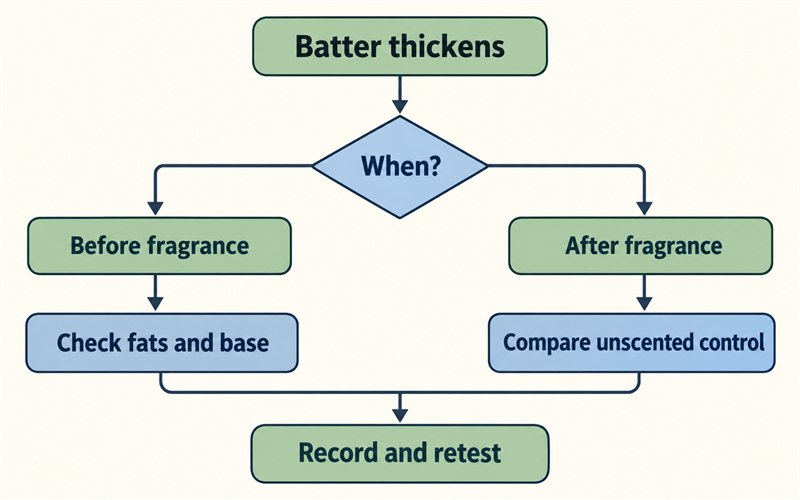
For a batch that changes immediately after fragrance addition, a matched unscented comparison is a useful next investigation. Keep the base, scale, temperatures and mixing procedure comparable, and record what happens at the same stages. This is a development comparison proposed from the application evidence, rather than a certified laboratory method.
- Both trials thicken early: examine the base, hard-fat condition and process before selecting a replacement scent.
- Only the scented trial changes under matched handling: investigate fragrance compatibility at that dose and stage of addition.
- Results differ between repeats: check temperatures, ingredient identity and mixing consistency before drawing a conclusion.
A repeated difference implicates fragrance addition under those conditions. It still leaves the chemical pathway open. For a buyer, the immediate decision is whether this combination gives enough working time for the intended bar and design. Keep the recipe and observation record so the next supplier discussion has something concrete to compare.
Choose the next action from the symptom
For a still-fluid batch that accelerates, simplify the pour and avoid unnecessary stick blending. Bramble Berry recommends hand stirring for difficult fragrances. For mild ricing, Wholesale Supplies Plus reports that blending can remove small lumps; that option depends on retaining enough flow to handle the batch. Stop chasing smoothness if the mixture is becoming unmanageable.
For a seized or separating trial, record the onset, take photographs and hold it out of customer stock pending appropriate formulation and quality review. Avoid improvised additions of water, oil or lye. A deliberate recipe change needs recalculation and a fresh trial. Restoring the appearance alone does not settle the release decision.
Keep fresh-batter handling precautions in place: CDC/NIOSH identifies sodium hydroxide as an eye and skin burn hazard. Follow your established protective-equipment and splash-prevention procedure while investigating. The aim is to learn from a small trial without turning a difficult pour into an uncontrolled recovery attempt.
Ask for a test result you can actually compare
Scent families are a poor substitute for application records. CandleScience reported no acceleration, ricing or separation in its August 2026 Orange Blossom test. That is a useful exception to the claim that every floral fragrance causes trouble. It supports this blend under its recorded conditions, without predicting your recipe or clearing every floral scent.
The comparison base matters too. CandleScience changed its cold-process testing recipe from 2025. When two ratings come from different bases or dates, ask for the underlying method. Request the exact fragrance identity, base formula, dose and calculation basis, temperatures, addition stage, mixing and observed working time.
For your next sample, keep an unscented comparator, document the addition, photograph changes and change one variable at a time. Evaluate the finished sample’s scent, colour and quality through the established process, then repeat the promising combination in the intended design. Agree on the required working window before approving a larger run.
Request intended-use documents separately from handling notes. The IFRA 51st Amendment guidance lists bar soap in Category 9. Confirm the exact blend’s current certificate and the correct finished-product concentration basis. IFRA explains that a Certificate of Conformity does not replace a safety assessment or applicable local requirements. It also cannot predict pouring behaviour.
As checked in October 2026, IFRA’s latest 52nd Amendment announcement expects formal notification in January 2027. That expectation supersedes its earlier timetable. Recheck the applicable documentation when approving a project; an expected notification is a different status from an effective requirement.
Questions to resolve before the next trial
Can the fragrance name reveal the problem ingredient?
A floral or spicy description does not disclose the complete fragrance ingredients. Ask for blend-specific application information and a comparable test. Avoid assigning a molecular cause from the marketing name.
Should I replace the fragrance or adjust the recipe first?
If the unscented trial also struggles, start with the base and handling. If the issue repeatedly appears with fragrance under comparable conditions, discuss a blend alternative or a narrowly defined application adjustment with the fragrance supplier. Keep the desired design and working time in the brief.
What should I send with a development inquiry?
For a Scentake project brief, include the intended bar soap, target market, scent direction, base recipe, fragrance dose, mixing temperatures and the change you observed. Add comparison photographs and available supplier documents. These details connect the formulation question to a sample project with clear acceptance criteria.
Discuss your fragrance brief with Scentake and define the recipe-specific sample evaluation before committing to production.