
What Is the MOQ for Custom Perfume Manufacturing and What Affects It?
A first perfume order can fit the filling line and still leave a shelf of unused bottles. It happens when the number on the finished perfume quote and the number on the glass quote refer to different things. Buyers need both quantities before they can budget for a launch.
The minimum order quantity, or MOQ, is the smallest quantity a supplier agrees to take for a defined order. A Texas perfume development and manufacturing provider, Project Fragrance, lists 250 finished units per fragrance for its library-based private label route and 500 units per fragrance for its full custom development route. These figures apply to those offers. Your quote will depend on the scent, the finished product and the packaging you specify. Project Fragrance private label and full custom development.
Check how the supplier counts each product
Ask the supplier to put a unit next to every minimum. A quote may count bottles per fragrance, units per stock keeping unit (SKU), or units across the whole order. A SKU identifies one sellable version. A 30 mL spray and a 50 mL spray may have different SKUs even when they contain the same scent. Ask how the supplier counts that split and whether changing the carton artwork creates another minimum.
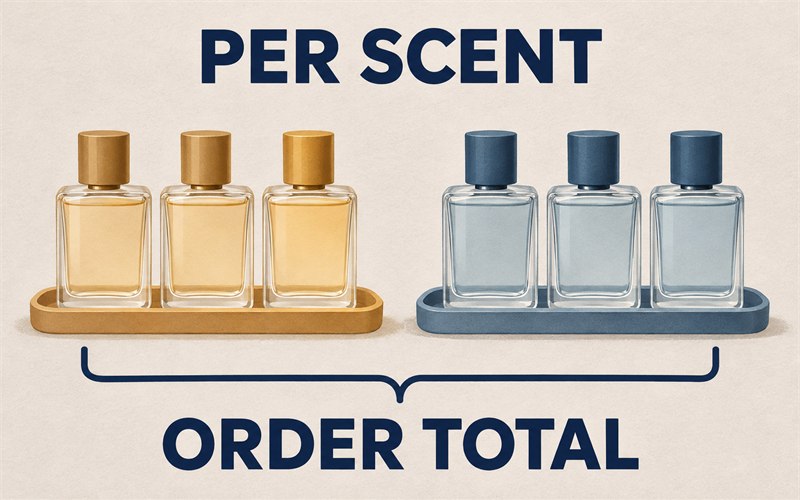
South Korean perfume manufacturer RAINT publishes two conditions for its OEM and ODM perfume service. It lists 2,000 units per scent and 5,000 units in total. In that example, two scents at 2,000 bottles each meet the scent minimum and come up 1,000 bottles short of the order minimum. Ask for the allowed allocation before assuming that a combined order qualifies. RAINT perfume manufacturing terms.
Compare what each development route includes
A library fragrance with selected packaging and a perfume developed from a new brief are different projects. Project Fragrance’s two starting quantities come with different service scopes. Use them as examples of what a supplier can offer and compare your own quotes with the same brief, bottle size and packaging specification.
Ask whether the fragrance house, the filling partner or both have a minimum. A supplier may quote the concentrate by weight and the finished perfume by bottle. Ask the filler to confirm how much concentrate the planned run uses and how any unused material would be handled. The custom perfume development guide explains how to tie that run to the approved formula and finished sample.
Read the packaging minimum separately
An existing bottle mould and a bottle in stock describe different arrangements. The glass supplier Rango Packaging lists made-to-order bottles from an existing mould starting at 5,000 pieces per design. For a custom mould, its FAQ lists 10,000 pieces or more per design, subject to evaluation. These are empty glass commitments from that supplier. The number of filled bottles belongs on a separate line of your quote. Rango Packaging glass bottle FAQ.
Ask about the bottle, pump, cap, label and carton individually. The same undecorated glass might serve several scents if the supplier allows the parts to be pooled. A different finish or printed carton can have its own minimum. Ask whether the glass is in stock now, will be made on an existing mould, or requires new tooling. For an alternate pump or cap, confirm fit and performance on the finished sample before ordering parts.
Count what remains after the first run
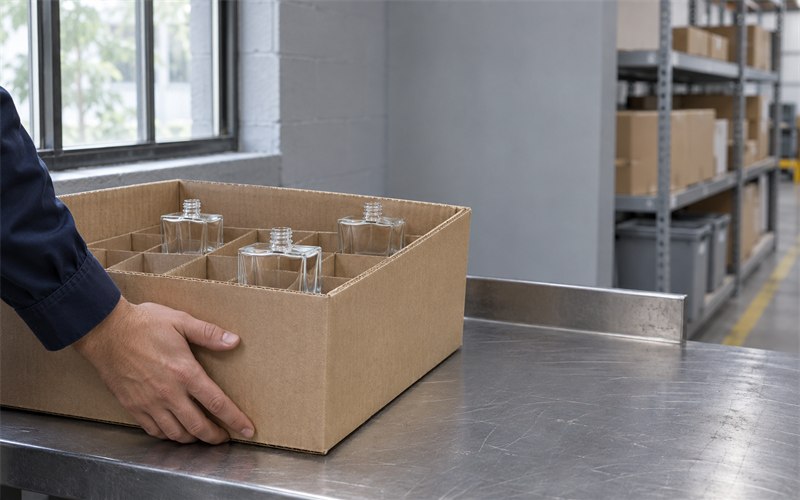
Imagine a quote for two scents at 250 finished bottles each. Both use the same undecorated glass and separate labels. The bottle supplier sells that glass in lots of 1,000, and the filling partner confirms it can share the glass across both scents. Filling the planned 500 units uses 500 bottles, leaving 500 empty bottles before any samples, rejects or breakage.
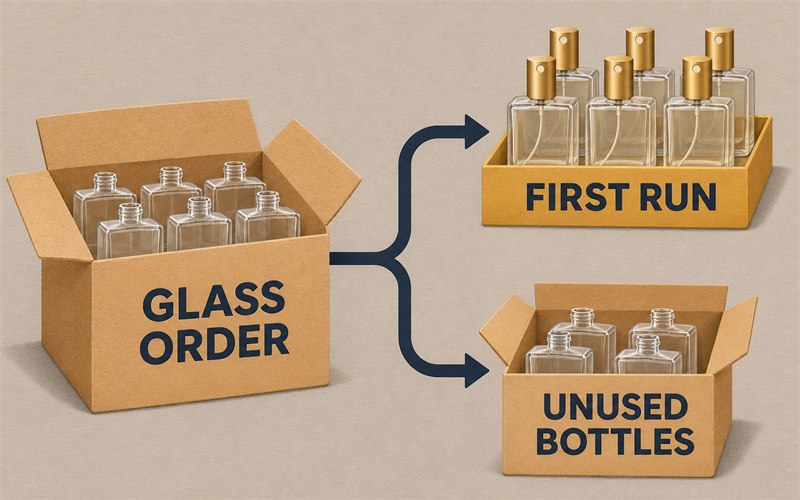
The 500 leftover bottles are part of the purchase commitment. Ask who pays for them, who owns them and where they can be stored. If you intend to use them later, ask the filler to quote a reorder using those parts and to explain any storage terms. Repeat the count for pumps, caps and cartons that have separate minimums.
Put the same questions to every supplier
Send one product brief and ask each supplier to show the following quantities and charges on its quote. This gives you a way to compare the amount you pay for with the amount you can sell from the first run.
- Finished order. List the requested bottles by scent and size, each applicable minimum and the total required order.
- Fragrance and filling. Identify the development route, any separate concentrate or fill minimum and the unit used for each.
- Packaging. List the minimum and expected use for every component and decoration. Confirm which parts can be shared.
- Unused stock. State the remaining quantities, who owns them and who pays for storage or delivery.
- Repeat order. Request the minimum for a repeat of the same version and a separate quote for any planned change.
If the first order is too large for the demand you can verify, ask for a second quote with one launch scent and a bottle that is already in stock. Compare the upfront commitment as well as the price per finished bottle. Ask which parts of the design you can still change on a later order.
Questions to ask before accepting the MOQ
Can I split the minimum across several scents?
Get the split approved on the quote. Ask for the minimum per scent or SKU, the order total and the smallest allowed quantity of each variant. Put the agreed quantities next to the corresponding scents and sizes.
Does a stock bottle automatically reduce my MOQ?
A stock bottle can give you another packaging option if the supplier has the model and quantity available. Confirm the minimum for decoration, the matching pump and closure, and the filling run. Any of those items can still set a separate commitment.
Will the reorder minimum be lower?
Ask for a repeat-order quote based on the approved formula and component versions. Include a count of usable leftover parts. The repeat run still needs an agreed minimum, especially if a component has been discontinued or the artwork changes.
Share the quantities you want to launch with
For a Scentake project discussion, bring the scent count, bottle size, intended sales markets and planned first-order quantity for each version. Note whether you want a library direction or an original composition, and which parts of the packaging you can adapt. Explore custom perfume development or send your launch quantities and brief.