
What Are Fixatives in Perfume? How They Improve Longevity and Stability

The perfume is still there, yet the scent you liked at the start has slipped away. A warm base remains where a bright opening used to be. When you ask for better longevity, that difference matters: keeping something detectable and preserving the character you wanted are separate goals.
Fixatives in perfume are materials used to support persistence or modify how a fragrance evaporates. Some contribute their own lasting smell; others can affect the release of surrounding ingredients. Their contribution to stability needs a more precise question. A smoother evolution during wear, a clear liquid and resistance to chemical deterioration are different outcomes.
What fixatives in perfume actually do
The word describes a formulation role rather than a single family of chemicals. A 2022 review in the peer-reviewed Beilstein Journal of Organic Chemistry describes how base-note materials can serve as fixatives, with some amber materials also enhancing perceptibility. That allows a material to help shape the smell while contributing to its persistence.
Think of a lasting base as part of the perfume’s design. If its character suits the fragrance, it may make the drydown more satisfying. It does not, by itself, demonstrate that the lighter ingredients stayed longer. Ask what remains recognisable: the floral heart, the citrus theme or simply the base. This is especially useful when comparing ways to extend a citrus perfume.
How a formula can slow the release of other materials
There is evidence for effects beyond a fixative’s own smell. University of Cincinnati researchers Saiyasombati and Kasting reanalysed human skin evaporation measurements in 2003, comparing closely matched mixtures with and without a musk. The musk-containing version changed the release profiles of other ingredients; dihydromyrcenol evaporated at a sustained rate for longer in that version.
The authors proposed that the musk reduced other ingredients’ thermodynamic activity: in plain language, their tendency to escape from the mixture. That is a proposed explanation for the observed behaviour. Their models did not fully account for the interactions, so the paper does not establish a universal molecular mechanism for every fixative.
A 2024 model-perfume study in Flavour and Fragrance Journal reported fixation effects for tested alpha-ketoesters on a subset of fragrance volatilities, with molecular structure influencing the effect. Choosing the heaviest-sounding ingredient is therefore a poor substitute for testing the actual combination.
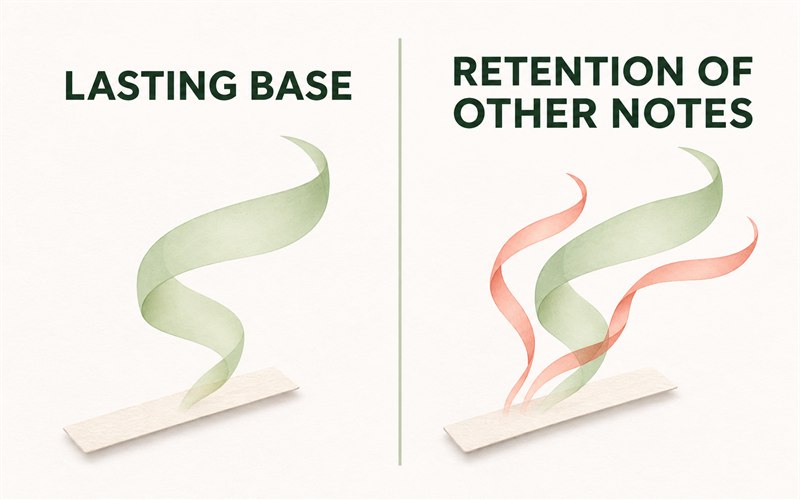
For a sample comparison, separate two questions: is the overall perfume detectable for longer, and are the notes you wanted to retain still recognisable? An improvement in the first can leave the second unresolved.
Choose the role before choosing the material
Specialty chemical manufacturer LANXESS describes benzyl benzoate as a solvent and fixative, with a faint balsamic odour. This is manufacturer information about the material’s roles, rather than a comparative wear test. It illustrates why a name on a supplier list tells you less than a clear explanation of its job in your formula.
- For scent character: ask what the addition contributes to the opening, heart and drydown. Compare it with the approved reference.
- For retention: ask which other materials or notes are expected to last longer and what comparison supports that expectation.
- For solvency: ask whether it helps the actual concentrate remain dissolved at the intended alcohol and water balance.
Those jobs can overlap, but each deserves its own observation. A solvent role does not establish that a proposed dose will keep every perfume clear, and a persistent odour does not establish retention of the whole accord. Request the exact material identity and formula version alongside the sample.
Stability in the bottle is a separate development task
Start by naming the problem. A fragrance that fades too quickly on a blotter has a different issue from one that becomes cloudy in its bottle. A stored perfume that develops an unwanted smell raises another question. Calling all three problems “poor fixation” makes it harder to choose the right investigation.
In a 1987 study of chemical reactions during perfume ageing, researchers followed changes in perfume materials mixed with alcohol and water under influences including air, heat and daylight. The work also examined protective additives. It provides a useful warning against treating resistance to evaporation as proof that a formula is protected from chemical change.
The International Organization for Standardization’s ISO/TR 18811:2018 guidance on cosmetic stability testing leaves manufacturers to specify and justify a suitable protocol. It does not prescribe one set of conditions for every product. For a brand buyer, the useful request is a test plan for the finished formula and intended packaging, with agreed observations and acceptance criteria.
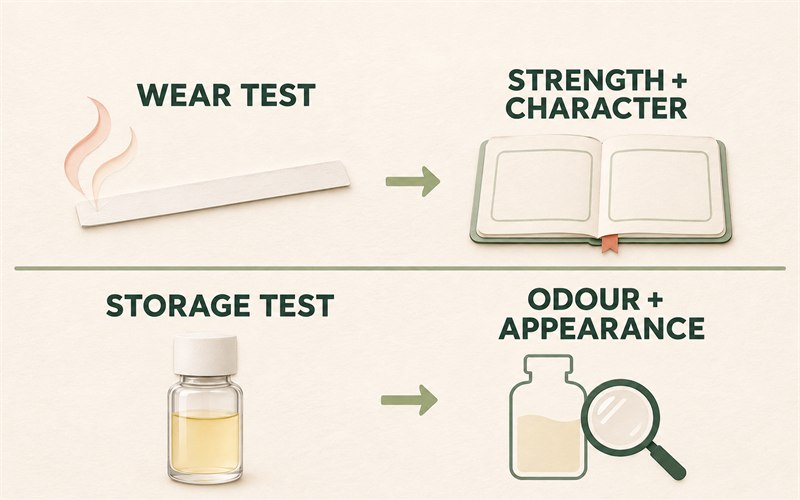
Track clarity, colour, odour and packaging behaviour separately from wear performance. If a candidate fixative also improves physical compatibility in your formula, document that result as such. It still leaves chemical stability to be assessed through the appropriate protocol.
Compare the finished perfume against a reference
Paper-strip persistence alone cannot describe every wearer. A small 2025 study by Université Le Havre Normandie researchers found that the release of fragrance materials varied with molecular and skin properties. It examined an ethanolic mixture on volunteers’ forearms, rather than testing a fixative upgrade. Its practical relevance is the need to assess the intended finished perfume as well as the strip.
- Define the target. Specify the character you want to retain and the drydown change you would accept. “More lasting” is too broad to guide the comparison.
- Keep a reference. Ask the perfumer for an unchanged sample and a documented variant. Record composition changes, concentration, solvent balance and sample date.
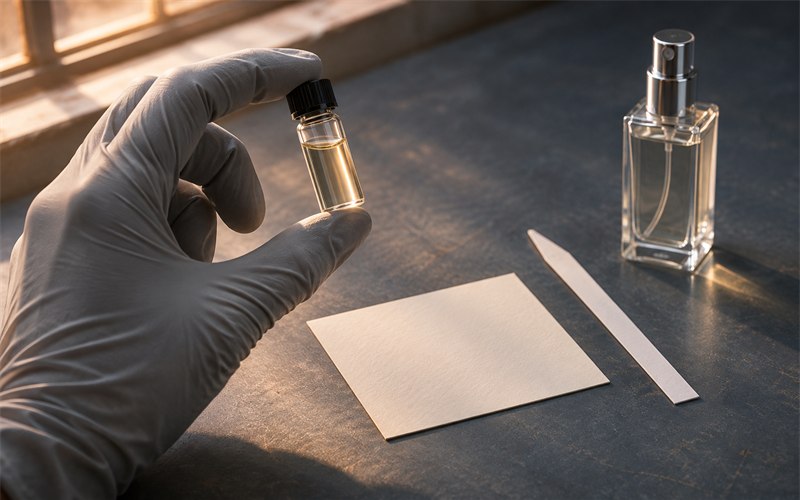
- Match the comparison. Use the same application amount and method, with comparable evaluation conditions. For wear evaluation, use only samples prepared and cleared for that intended use.
- Record strength and character separately. Revisit samples at agreed intervals, leaving gaps between checks. Note both what remains detectable and whether the desired accord survives.
- Run the storage assessment separately. Have the manufacturer define the conditions and criteria for the final formula in its intended pack. Keep those results alongside the wear notes.
This is a practical comparison framework, not a complete product-release test. Use the result to decide whether the revision preserves your concept before approving the next sample or production specification.
Questions to settle before adding a fixative
What percentage of fixative should a perfume contain?
There is no universal percentage supported by the evidence discussed here. The relevant amount depends on the identified material, its role and the complete formula. Ask the perfumer to document the proposed level, how it is expressed and why it was selected, then compare the prepared samples rather than copying a generic dose.
Can I add a fixative to a perfume I already own?
For a purchased perfume, the more useful step is to ask the maker about its intended drydown and compare alternatives. Adding another material changes the finished formula without giving you the original composition or a controlled reference. A development project allows a formulator to prepare and assess that revision properly.
Does better longevity also mean stronger projection?
Treat them as separate evaluation questions. For longevity, record whether the scent remains detectable over time. For projection, agree how you will judge its noticeability at a chosen distance. In a sample brief, specify both the character you want to retain and how noticeable you want it to be, then compare those goals separately.
Give your perfumer a specific performance brief
A useful brief might ask for the heart to remain recognisable after the opening softens, while limiting how much the base changes its character. Add the intended product format, sales markets, cost range, packaging and the reference sample. Identify whether the unresolved problem is wear, clarity or storage odour.
For a custom perfume project with Scentake, bring that brief and the comparison notes to the discussion. Share the scent direction and the specific result you want to improve, so the next sample can answer a defined question and give you a clearer basis for approval.