
Why Citrus Perfumes Fade Quickly and How Perfumers Make Them Last Longer
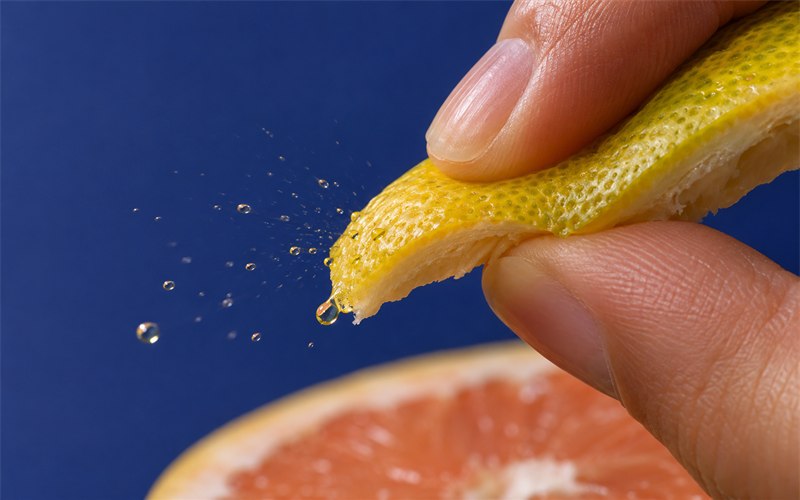
The grapefruit sparkle you loved at the perfume counter may become much harder to recognise later, even while a woody or musky scent remains. That is a different disappointment from finding no fragrance at all.
Citrus perfumes can feel fleeting because their bright opening often relies on readily evaporating materials. As the mixture changes, the recognisable citrus effect can recede. Perfumers can extend that impression through more persistent citrus-smelling materials, a carefully balanced accord and adjustments tested in the finished base. Keeping a citrus character is a more specific goal than making any part of the perfume last longer.
The citrus accord changes as its ingredients evaporate
For an ingredient to be smelled, some of it must reach the air. A 2022 peer-reviewed review in the Beilstein Journal of Organic Chemistry explains the connection between vapour pressure and substantivity, the persistence of an odour on a test strip. It uses limonene as a familiar fresh, citrus top-note example. The same classification cannot give every finished citrus perfume an identical lifespan.
A citrus oil is itself a mixture. In a 2015 experiment on commercial citrus oils, researchers followed changing composition during forced evaporation under nitrogen. Different components were lost in different proportions. The relative share of limonene actually increased in the sweet-orange residue, which shows why “the limonene disappears first” is too simple an explanation.
Those laboratory conditions were different from wearing perfume. The useful lesson is that evaporation changes the balance of a citrus mixture. You may lose the particular combination that suggested fresh peel while other fragrant material remains. When assessing a sample, write down what the later scent has become, alongside whether you can still detect it.
Your nose can make fading harder to judge
Physical evaporation is only part of the assessment. A 2017 controlled-exposure study in Scientific Reports examined olfactory habituation: reduced perceived intensity during continuing exposure. Odorants were delivered at constant concentrations, yet participants’ responses changed, with differences between odorants. This was a laboratory perception study, rather than a trial of citrus perfumes worn through a day.
Repeatedly checking the same wrist therefore gives you an imperfect answer to “has it gone?” For a more useful comparison, leave gaps between checks and ask another person to assess the sample without telling them which one is supposed to last. If they notice scent while you do not, record that disagreement. It is a reason to investigate perception, rather than automatically increase the dose.
Perfumers can carry the citrus character into the heart
The brief does not have to end with more lemon or orange oil. A perfumer can explore materials that suggest citrus while offering a different persistence profile, then build a transition from the opening into the heart. The creative question is how to keep the fruit recognisable as the composition develops.
Fragrance ingredient manufacturer IFF describes its Nootkatone Crystals as having a powerful grapefruit/citrus aroma and reports substantivity in its technical record. That makes it a concrete candidate to discuss when developing a grapefruit direction. The record does not disclose conditions sufficient to turn that supplier performance claim into a finished perfume’s wear-time promise.
| Development choice | What you want to learn | What to watch for |
|---|---|---|
| Explore persistent citrus-smelling materials | Does the fruit remain recognisable later? | The result may move away from the fresh-peel opening you wanted. |
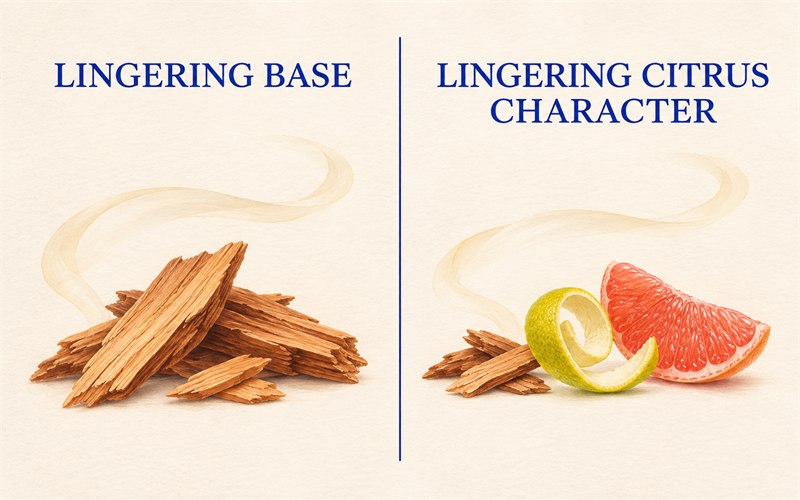
| Rebalance the heart and base | Do supporting notes leave room for the citrus effect? | A lasting base can become the main smell. |
| Adjust the finished base or fragrance load | Does the revised product perform better in use? | Judge character, application and documentation together. |
Use the table as a development brief, not a universal recipe. For example, ask for a revision that keeps a recognisable grapefruit character after the opening, alongside a separate revision focused on overall persistence. Comparing them makes the trade-off easier to discuss than asking for a sample that is simply “stronger.”
Fixatives and carriers need a complete-formula test
A fixative should not be imagined as a lid placed over citrus molecules. In their published modelling analysis, pharmaceutical researchers Penpan Saiyasombati and Gerald Kasting reported limonene evaporating more slowly from analysed mixtures than a model without ingredient interactions predicted. They implicated interactions with fixatives. That is a qualified explanation of the observed model mismatch, rather than proof that any musk will preserve any citrus accord.
The delivery base also belongs in the comparison. A 2019 peer-reviewed study recorded in Universidade Católica Portuguesa’s research repository investigated ethanol-diluted fragrance systems using porcine skin and a diffusion cell. It considered evaporation and skin permeation together. It was not a consumer comparison establishing that oil perfumes always outlast alcohol sprays.
If you are considering a format change, first identify the perfume’s carrier and alcohol compatibility. Evaluate the proposed finished product rather than adding a solvent or carrier to a bottle and assuming the change has solved longevity. Keep the formula version, base and application method with each sample’s notes.
Compare samples for citrus character as well as strength
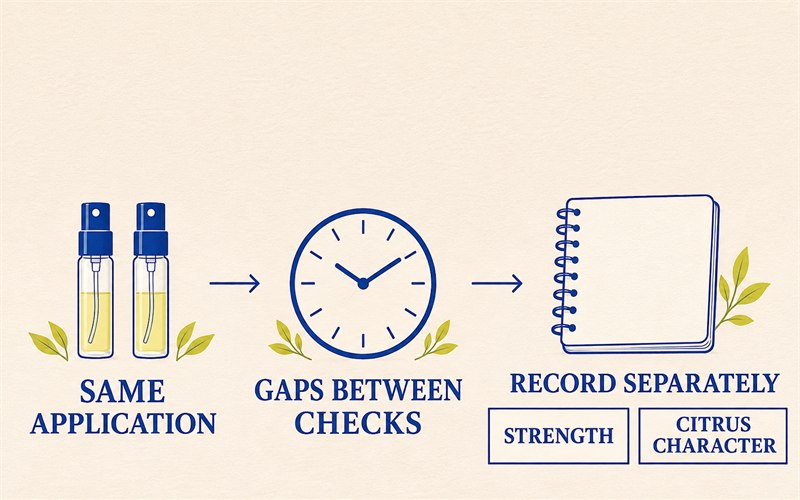
A useful wear comparison keeps two questions separate: can you still smell the perfume, and does it still smell citrus-led? Here is a practical screening approach for selecting samples. It is a comparison aid, not a laboratory method for certifying performance.
- Use finished products according to their directions. Keep the application amount and method consistent between comparisons.
- Give samples neutral codes. Record each formula version, test date, setting and where it was applied.
- Agree on check points in advance, including the opening and later in the day. Leave gaps between smelling sessions.
- Record overall strength and citrus character separately. Describe the later smell in plain words, such as grapefruit, floral, woody or mostly musk.
- Compare more than one wearing occasion and, where practical, another person’s assessment. Treat a paper-strip comparison and a skin comparison as different observations.
For a buying brief, specify the citrus impression you want to retain, the finished format, intended use setting and an agreed later check point. A reference fragrance can help explain the desired character. Keep a minimum acceptable citrus impression separate from any requirement for a detectable background scent.
To discuss a citrus fragrance project with Scentake, send your scent reference and sample brief. Include the base, target market and comparison notes so the discussion can address formulation, documentation and the next sample, alongside the smell you want to achieve.
Questions to ask before choosing a longer-lasting citrus perfume
How many hours should a citrus perfume last?
There is no reliable single figure for the entire category. Ask whether a claimed duration refers to recognisable citrus, any detectable scent, a test strip or skin. A relevant wear comparison is more useful than a fixed-hour chart that leaves those conditions unspecified.
Will an eau de parfum always retain more citrus than an eau de toilette?
The label alone cannot answer that. Ask whether you are comparing the same composition at different loads or different formulas, and judge the later citrus impression directly. More lingering base scent can satisfy a strength preference while missing the fresh character you wanted.
Can I make it last by adding citrus essential oil?
That changes the formula and introduces new questions about suitability and use level. Do not apply a concentrate neat or treat extra essential oil as a ready-made fix. Our guide to finished skin perfumes and fragrance concentrates explains the distinction to check first.
Does a musky dry-down prove that the citrus was fixed?
It shows that you can still smell something in the perfume. To judge the specific goal, ask whether the citrus character remains recognisable at the agreed check point. Record both answers so a long-lasting base is not mistaken for a longer-lasting citrus impression.