
Can You Mix Perfume Oil with Alcohol? Solubility, Carriers and Sprayable Oil Bases
You have an oil perfume you enjoy, and a spray bottle seems like a convenient way to use it. Adding alcohol looks like a small change. The difficult part is knowing whether the bottle contains a fragrance concentrate, a finished perfume diluted in a carrier, or a mixture designed for a different application.
You can mix some perfume oils with alcohol successfully. The name alone cannot tell you which ones. A concentrate intended for an alcohol perfume is a more sensible starting point than an unidentified roll-on formula. Check the carrier, the alcohol’s composition and the proposed fragrance load before committing the whole bottle.
Identify what is inside the perfume oil first
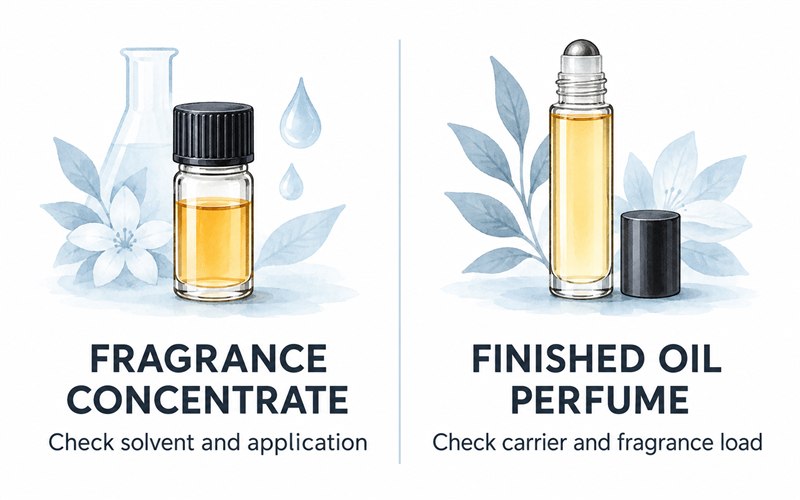
A fragrance concentrate and a finished oil perfume can both look like an oily liquid. One is a material for further formulation; the other already includes a delivery base and may be intended for direct application. Treating them as the same starting material makes both compatibility and dilution harder to judge.
| Starting material | Information you need | Useful next step |
|---|---|---|
| Fragrance concentrate | Solvents, intended uses and compatibility with the proposed alcohol base. | Request an alcohol-perfume sample at the intended fragrance load. |
| Finished oil perfume | Carrier identity and how much fragrance is already present. | Ask the brand whether conversion to a spray has been evaluated. |
| Oil for another application | Whether the material is intended for skin fragrance at all. | Confirm the application before investigating a mixing ratio. |
Fragrance materials supplier PerfumersWorld, for example, records oil and ethanol solubility for one product in a 2021 certificate of analysis. The same record describes it as insoluble in water. That is evidence about the named supplier material, rather than a promise about every bottle sold as perfume oil. Ask for equivalent current information about yours.
Why alcohol can dissolve one blend and leave another cloudy
Solubility depends on how the molecules in the liquid interact. OpenStax, the educational publisher based at Rice University, explains in its chemistry treatment of liquid solubility that the balance of intermolecular attractions helps determine whether liquids mix. Some pairs mix readily; others have limited mutual solubility and form separate layers.
A perfume is a mixture of materials, so the question concerns the complete blend. Adding alcohol changes the solvent environment around the fragrance and its existing carrier. Adding water changes it again. A material that dissolves in one base may behave differently in a wetter base or at another loading.
The Tisserand Institute, an essential-oil education organisation, discusses the importance of alcohol amount, strength and oil composition in its aromatic blending guidance. Its context is essential-oil sprays. For your perfume, the useful lesson is to record both the alcohol you buy and the water in the final mixture, rather than assume that any liquid labelled alcohol does the same job.
Shaking can temporarily disperse incompatible liquids. A sample that looks mixed while moving may separate when left to rest. Haze, sediment and layers are observations to investigate; they do not identify a single offending ingredient without a comparison.
Carriers deserve more attention than the word oil
Jojoba, MCT, dipropylene glycol and isopropyl myristate belong to different material families. Knowing their names gives you a better question for the supplier, although it still leaves the full formulation to assess.
Chemical manufacturer Dow describes its low-odour dipropylene glycol grade, commonly abbreviated DPG, for fragrance and cosmetic solvent applications in its Guide to Glycols. A perfume using DPG therefore calls for different compatibility information from one using a vegetable oil. The guide cannot establish that DPG will dissolve every fragrance at every load.
Isopropyl myristate, or IPM, supplies a useful counterexample to the idea that all oily carriers reject alcohol. Japanese chemical supplier FUJIFILM Wako lists its specified IPM material as soluble in ethanol and practically insoluble or insoluble in water in section 9 of its safety data sheet. That research-grade document explains a chemical property; select an appropriate cosmetic grade for a skin product and evaluate the finished blend.
For jojoba or an MCT-based perfume, request compatibility information for the actual grade and formula. Avoid turning a missing data sheet into a confident yes or no. A product marketed as a fragrance ingredient also needs its intended application confirmed, regardless of how pleasant it smells.
A sample check that can answer the practical question
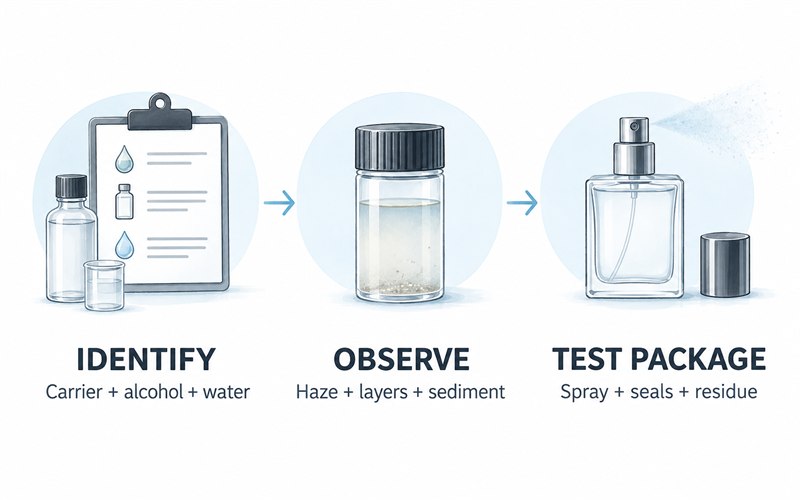
A small, documented comparison is more useful than repeatedly adding alcohol until the mixture looks acceptable. Agree on the intended formula and package first. The following sequence is a screening proposal; a commercial release needs its own acceptance criteria and assessment.
- Record the starting materials. Keep the fragrance identity, carrier information, alcohol grade, water content and supplier documents. If the starting material is a finished perfume, establish its existing fragrance load.
- Prepare a limited sample by mass. Record the composition so the result can be reproduced. Keep a sample of the original material for comparison, and use clean, compatible containers.
- Observe after mixing and resting. Note clarity, haze, layers, sediment and smell. Ask a formulator to define appropriate storage and temperature checks for the planned product.
- Try the intended package. Check spray pattern, leakage, seals and residue after the formula review. A result in an open glass container does not answer those package questions.
- Review before scaling. Compare the findings with the brief. If the sample separates or the package performs poorly, revisit the base or concentrate with the supplier.
Filter out an observed precipitate only after investigating it. Removing material can change the formula you intended to make. Likewise, extra shaking or a stronger scent cannot stand in for an explanation of recurring separation.
Keep alcohol handling and skin suitability in the decision
The US National Institute for Occupational Safety and Health (NIOSH), part of the Centers for Disease Control and Prevention, identifies ethanol as a flammable liquid in its chemical hazard guide. Keep trial work away from flames, sparks and heat, follow the material’s handling instructions, and do not use warming as an improvised way to force a troublesome sample clear.
A clear solution answers an appearance question. Skin suitability needs separate consideration of the ingredients, their amounts and the intended use. The US Food and Drug Administration (FDA), the US cosmetic regulator, explains in its fragrance safety guidance that manufacturers and marketers are responsible for cosmetic safety. An ingredient SDS or a solubility note does not approve your finished perfume.
Questions that matter when converting an oil perfume
Does adding alcohol make a finished perfume stronger?
Adding a diluent reduces the fragrance proportion if you add no further fragrance. A finished oil perfume already contains its own carrier, so the amount of that product you pour in is different from the amount of aromatic concentrate. Establish the starting composition before attaching a concentration description to the new mixture.
Can I use rubbing alcohol instead?
Check the chemical identity and additives rather than treating alcohol as a single ingredient. A base containing isopropyl alcohol is different from an ethanol base. Ask for a material intended for your cosmetic application and its supporting specifications; do not assume that a household product is an interchangeable perfume solvent.
Can an alcohol-free oil be sold in a spray bottle?
That is a formulation and package question. Adding ethanol creates an alcohol-containing product. Keeping an oil base requires a dispensing system that works with that particular liquid. Evaluate delivery, residue and leakage in the proposed package instead of expecting any atomiser to make an oil behave like an alcohol perfume.
Does a clear sample mean I can make a larger batch?
Initial clarity is one checkpoint. Complete the relevant storage, package and finished-formula review before scaling. Preserve the sample’s composition and supplier version information so a later batch can be compared with the material you actually evaluated, especially if a carrier or alcohol grade changes.
Ask for a spray project rather than a conversion guess
When the oil’s composition is unavailable, obtaining a concentrate designed for the intended spray can be a clearer development route. A useful discussion with a fragrance supplier starts with the scent direction, product format, base, target markets and package.
Scentake approaches fragrance development through the brief, sample and supply-chain discussion. Share the oil or concentrate information and the spray format you want, together with the intended selling markets. Agree on which composition and package checks need to be completed before an approved sample becomes an order.