
Niche vs Designer Perfume: Differences in Scent, Price, Marketing and Performance
Choosing between niche and designer perfume becomes easier when you separate the brand from the bottle. A fragrance house can belong to a large beauty group. A fashion house can offer an unusually focused scent. Neither label tells you how a perfume will smell on your skin after lunch.
The main difference is the brand’s origin and positioning. Niche perfumery traditionally puts fragrance at the centre of its identity; designer perfume carries the identity of a fashion or luxury house. Scent style, price, marketing and wear performance overlap. Use those labels to find interesting candidates, then judge the individual perfume against your taste, budget and daily life.
What niche and designer actually tell you
Fragrance Foundation France, an industry association that runs perfume awards, describes niche in a 2026 editorial as a historical business and cultural position rather than a guarantee of excellence. That is a useful starting point: fragrance-led identity and selective positioning help explain the category, while quality still needs a closer look.
Its 2026 niche award includes separate categories for independent and group-owned brands. Christian Dior appears among the entrants. Those competition rules illustrate how the boundary can blur, even within the industry.
| Question | Useful category clue | What to check yourself |
|---|---|---|
| Brand identity | Niche often centres fragrance; designer connects perfume to a wider house. | The brand’s history and the particular collection. |
| Scent | Niche may emphasise a focused concept; designer can also offer distinctive compositions. | Whether you enjoy the opening and dry-down. |
| Price | Premium positioning occurs in both categories. | Exact size, concentration, seller and total cost. |
| Marketing | Craft, heritage and exclusivity can appear in either category. | What is a product claim and what is a brand story. |
| Performance | The label gives no dependable wear guarantee. | Duration, projection and comfort in your setting. |
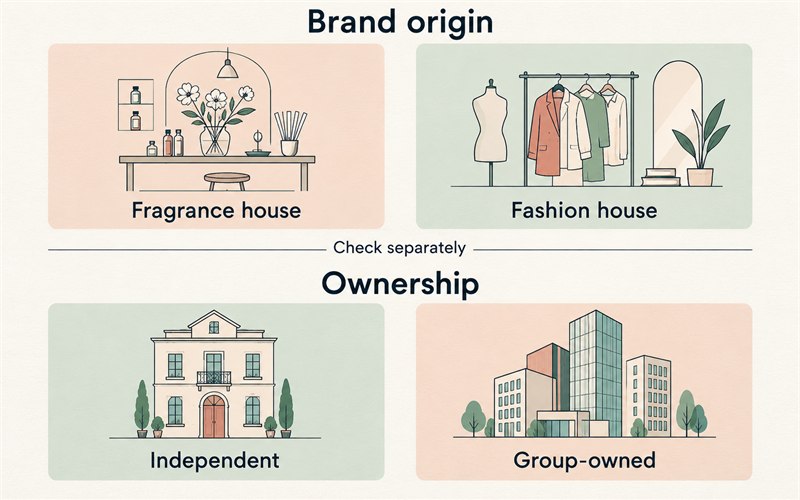
Ownership is a separate question. The Estée Lauder Companies, the beauty group behind several fragrance brands, records its acquisitions of Le Labo and TOM FORD in its investor information. If supporting an independent business matters to you, check current ownership instead of assuming that a niche identity establishes it.
Scent: compare the idea inside the bottle
Niche is often positioned around a particular creative idea. That can make it an interesting place to browse if you want a specific atmosphere, texture or unusual accord. It does not require you to enjoy a difficult scent, and a designer label does not rule out an individual character.
Consider two official descriptions. Fashion and fragrance house CHANEL describes Coromandel Eau de Parfum through an ambery composition featuring patchouli, vanilla and benzoin. Fragrance and home-scent house Diptyque describes Philosykos Eau de Parfum through the fig tree, with leafy greenness, wood and white cedar.
These are the brands’ descriptions of named perfumes, rather than independent smell tests. They nevertheless give you useful sampling directions: explore Coromandel if its warm, resinous idea appeals; try Philosykos if you are drawn to a green, woody fig impression. Your response to the samples settles which you prefer.
A note list describes an intended smell without revealing the full formula or the proportion of natural materials. Our guide to fragrance ingredients helps explain that distinction. Before shopping, write down the qualities you want, such as dry woods or restrained sweetness, and the qualities you would rather avoid. That brief will narrow your choices more effectively than a category badge.
Price: premium collections cross the category boundary
The idea that designer perfume is always the affordable option breaks down when you include exclusive collections. When checked on October 7, 2026, CHANEL’s US Les Exclusifs catalog listed its eau de parfum entries starting at US$355. This is a collection starting price, rather than a matched-size comparison with a niche bottle, and retail prices can change.
A high shelf price tells you the amount charged. It does not disclose ingredient expenditure, development time, packaging cost or the seller’s margin. Without that information, claims that a niche premium pays mainly for better materials are difficult to substantiate.
For a useful comparison, put the exact products side by side: same country and currency, intended concentration, bottle volume, authorised seller and final price. Price per millilitre helps compare quantities; it cannot tell you how much you will enjoy wearing either scent. A large bottle can be poor value if it sits unused.
Set a ceiling before sampling. If the fragrance you prefer falls outside it, consider a smaller official format where available or keep searching. You do not need to justify an uncomfortable purchase by treating niche perfume as the next stage of becoming a serious wearer.
Marketing: both categories give you a story
The stories can feel different. CHANEL connects Les Exclusifs to the house’s history and Gabrielle Chanel. Le Labo’s brand presentation on its owner’s website emphasises a workshop experience, hand blending and interaction with clients. Each gives the buyer a particular way to understand the product.
A craft-focused story is still brand positioning. So is a heritage story. Neither example establishes how much the company spends on advertising or how its perfumes compare in a controlled test.
Separate the experience you value from the performance you need. You may enjoy a boutique consultation, a particular bottle or a personal connection to a house. Those can be legitimate reasons to buy. When the promise concerns lasting power, ingredient origin or exclusivity, look for a specific product statement and ask what supports it.
Performance: the formula matters more than the category promise
Scientific work helps explain why a broad label cannot replace a wear test. In a peer-reviewed 1995 skin study, researchers at fragrance company Firmenich measured a model containing eleven synthetic odorants. The ingredients diffused from skin at different rates, and their release differed between the tested alcoholic solution and soap application. The experiment examined ingredient behaviour, without comparing niche and designer brands.
A 2026 peer-reviewed paper by Le Havre Normandie university and fragrance-company researchers examined two fragrance materials on paper blotters. A formulation technology altered their release and retention. Paper retention does not establish how long a finished perfume will smell useful on human skin.
These findings support looking at the particular formula and test conditions. They do not demonstrate that the two categories have identical average longevity, or that one is consistently superior. Category-wide hour ranges would promise more certainty than this evidence provides.
Also decide what you mean by performance. Longevity concerns how long you can perceive the fragrance. Projection concerns how far it reaches around you. Sillage is the trail it leaves as you move. A perfume that stays close to the skin may suit a shared office; strong projection may suit your evening plans. Choose the behaviour that fits the occasion.
For a closer look at price and wear, see whether expensive perfume really lasts longer. The practical question remains how the candidate behaves during your own day.
Choose with a sample before choosing a category
Give yourself a simple buying sequence. Start with a scent idea, a setting and a budget. Select a few candidates from either category, then obtain samples through the brand or an authorised retailer where possible.
- Enjoy the scent first. Use a blotter for an initial impression. If it interests you, try it on skin according to the product’s directions and your usual precautions.
- Follow it into the dry-down. Note what remains after the opening changes. Do you still enjoy it, or does a sweetness, woodiness or texture become distracting?
- Check the intended setting. Wear candidates on separate, comparable days with a similar application approach. Record noticeable scent, reach and comfort. Different atomizers mean the spray count alone will not ensure an equal dose.
- Buy when the whole choice fits. If the smell appeals, the wear suits your life and the price is comfortable, the category has done its job. If one fails, sample another candidate or repeat a test that was unclear.
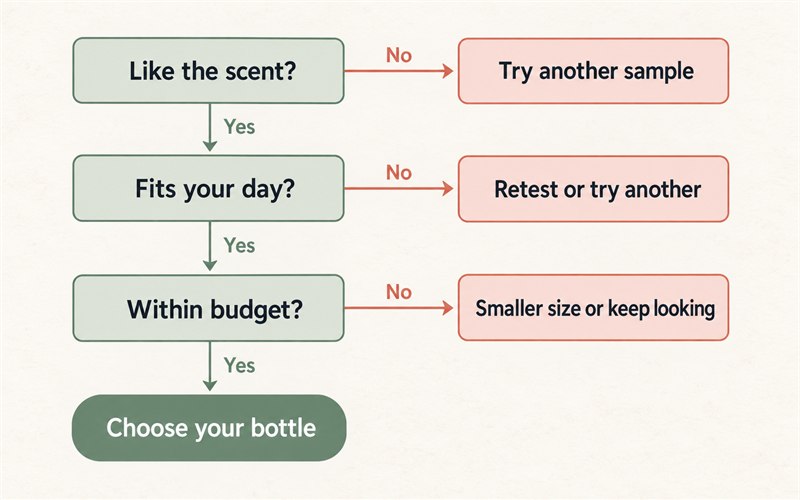
This is a personal comparison, with observations you can act on. You might discover that a designer perfume meets your daily brief and a niche scent suits a different mood. You might find one bottle that covers both. Either outcome is useful.
Questions that come up when shopping
Is niche perfume automatically better?
No. The label can help you find fragrance-focused brands and creative concepts, but it does not grade a particular perfume. Decide which scent you enjoy, how it wears and whether its price makes sense for you.
Do niche perfumes last longer than designer perfumes?
There is no dependable category guarantee. The studies discussed here investigate ingredient release under specific conditions, rather than a representative niche-versus-designer comparison. Sample the particular perfume if lasting power is important to your purchase.
Can a designer’s exclusive collection feel like niche perfumery?
Yes, if you mean a focused scent concept, a particular story or selective positioning. Exclusive collections are one reason the boundary becomes blurred. That resemblance does not establish independent ownership, superior ingredients or a fixed wear time.
Turn your preferences into a useful fragrance brief
If you are developing a fragrance for your own brand, replace a request for “niche quality” with details another person can evaluate. Name the desired aroma, the notes or textures to avoid, the intended wearer and market, the target retail position, and the wear priorities your sample comparison revealed. Describe the appeal of a reference without asking for an imitation.
As a fragrance development and global supply-chain partner, Scentake offers a place to discuss that brief. Understanding what a fragrance supplier should help you clarify makes the conversation more concrete. Contact Scentake with your scent direction and project requirements to discuss the next step.