
Does Expensive Perfume Really Last Longer? Price, Materials and Performance Explained

The expensive bottle looks convincing: substantial glass, a carefully chosen name, perhaps a scent you have wanted for months. Then comes the practical question. Will it still smell good when your day is nearly over?
Expensive perfume can last longer, and some comparative tests have found that advantage. Price alone does not guarantee it. Detectable wear depends on how the actual blend releases fragrance from your skin, the dose and conditions, and how you perceive it. Judge the exact perfume by its drydown and a repeatable wear comparison before treating a higher price as payment for extra hours.
Some pricier perfumes do last longer
UK not-for-profit consumer organisation Which? reported a longevity advantage for pricier brands in its December 2025 comparison with budget alternatives. Its wider perfume test used unbranded atomisers and more than 40 participants. In the selected branded-versus-budget comparisons, testers noticed the cheaper scents weakening after about an hour; most branded scents lasted three or more hours before beginning to fade.
Those observations give a buyer a reason to consider the premium. They concern selected products and perceived fading, rather than the moment every scent became undetectable. The public report does not provide enough detail to turn the result into a controlled, market-wide price rule.
If a particular expensive perfume earns its place through better wear, pay for that demonstrated benefit. Avoid assuming that every budget alternative performs identically, or that another costly bottle will deliver the same result.
| What you know | What it tells you | What to check next |
|---|---|---|
| The retail price | Your purchase cost | Whether the sample delivers the wear you need |
| A comparative wear test | How those products behaved under the reported conditions | Dose, application site, setting and definition of fading |
| An ingredient descriptor | The supplier’s description of one material | How the complete perfume behaves on skin |
| Your own sample notes | Your experience of that version and application | Whether the result repeats on another comparable day |
The formula controls what reaches your nose
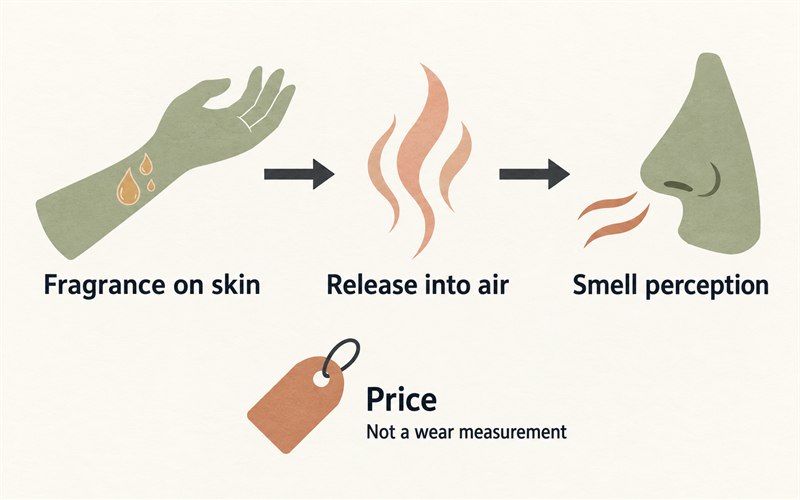
A perfume remains noticeable while enough of its fragrant materials reach your nose to be detected. Different materials leave the application site at different rates. The result also depends on their interaction with the skin and surrounding conditions; a retail price cannot describe those processes.
In a 2001 peer-reviewed paper, researchers at the University of Cincinnati modelled fragrance evaporation and absorption from skin using properties such as vapour pressure and lipid solubility, while accounting for temperature and airflow. The model was compared with data for two closely related mixtures. It helps explain the physical variables involved, without ranking commercial perfumes by price.
For a wearer, the distinction is tangible. The bright opening you enjoy may fade while a woody or musky impression remains. Decide whether you like that remaining scent. A perfume that stays detectable through a drydown you dislike offers little practical value, however impressive its duration sounds.
Ingredient origin tells you less than the finished blend
Fragrance ingredient producer International Flavors & Fragrances (IFF) describes Iso E Super’s woody, amber character and substantivity in its technical compendium. That is useful supplier information about one material. It is not a finished-perfume wear test, and its persistence descriptor should not become a promise of hours on your skin.
Perfume ingredient supplier dsm-firmenich also includes musks, ambers, woods and florals in its synthetic ingredient portfolio. Origin is a sourcing detail. Neither a natural claim nor a chemical-sounding ingredient name supplies the complete blend’s wear result.
Ask a more useful question: what remains after the opening, and does it suit you? Descriptions such as creamy wood, dry amber or soft musk can help you choose samples. They cannot substitute for wearing them. Expensive materials may be attractive for their scent character; persistence still needs its own assessment.
EDT and EDP can be different scents
Concentration labels are worth reading when you compare versions. They do not describe every detail of the formula, and a shared fragrance name does not establish that the contents differ only by dilution.
Perfume brand CHANEL illustrates this in its official descriptions of the BLEU DE CHANEL interpretations. It describes the Eau de Toilette through citrus, an aromatic accord and cedar, while the Eau de Parfum emphasises musky woods and ambery cedar. These are the brand’s descriptions of scent character, rather than independent evidence that one version lasts a specified number of hours.
Sample the version you intend to buy. When an EDP or parfum costs more, check whether you prefer its opening and drydown as well as its wear. A concentration upgrade that changes the character away from your preference can be a poor purchase even when it feels stronger.
Long wear and strong projection are different benefits
Longevity describes how long you can still detect the fragrance under a chosen check. Projection describes how noticeable it is at a distance. Sillage concerns the trail around movement. Keep those observations separate when reading perfume performance descriptions: a quiet scent close to skin and a noticeable scent across a table meet different needs.
A 2000 peer-reviewed review by Pamela Dalton at the Monell Chemical Senses Center, an independent taste-and-smell research institute, explains reduced sensitivity after repeated or prolonged odour exposure. Your own fading awareness can therefore differ from what a fresh observer notices. Actual evaporation also occurs, so adaptation should not become the automatic explanation for every disappointing perfume.
Before adding more, check at intervals and ask another person whether they can still detect the scent. Note whether they smell it only close to the application site or farther away. This is more informative than repeatedly sniffing your wrist and treating every quieter moment as complete disappearance.
Give each sample a fair wear test
A 2025 peer-reviewed methods paper by researchers at France’s Université Le Havre Normandie measured fragrance release above skin and several model surfaces, including a perfume strip. It used a defined mixture and a laboratory device, rather than a consumer comparison of luxury and budget bottles. For shopping, a strip is a useful first screen; it does not establish how the fragrance will wear on you.
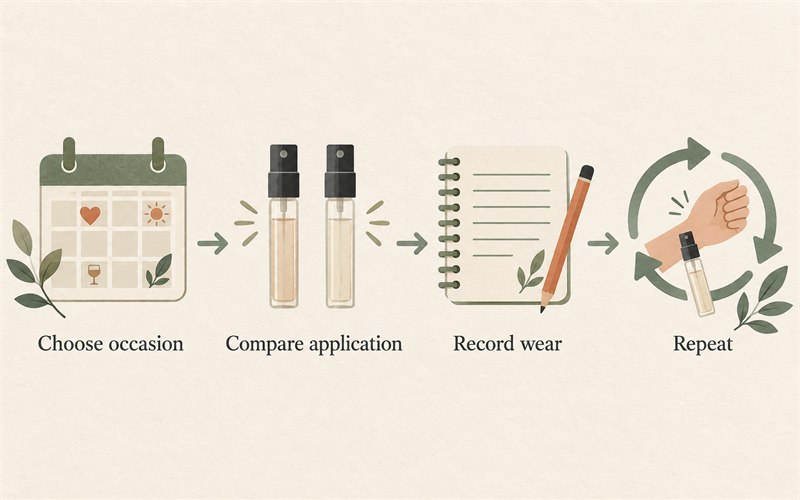
Use this practical comparison before committing to a bottle:
- Choose a real use case. Decide whether you want close-to-skin scent for work, a noticeable evening presence or pleasant wear until a particular point in your day.
- Make applications comparable. Follow product directions, use the same skin area on comparable days, and record the number of sprays. Different atomisers can deliver different doses, so equal spray counts are only an approximation.
- Set checks before applying. Record the settled opening, a middle-of-day check and the point when you need the scent to remain. These are your decision checkpoints, rather than promised wear times.
- Record separate observations. Write down the remaining scent, close-skin detectability, noticeability at a chosen distance and whether you still enjoy it. Include weather, activity and any reapplication.
- Repeat the comparison. Use another similar day and, where practical, a fresh observer. A repeated result is more useful for your purchase than one hurried shop visit.
Decide what the extra money is buying
A higher price may be worthwhile if the sample gives you a drydown you prefer, dependable wear for your occasion or a presentation you value. Keep those reasons explicit. Liking a bottle or a fragrance’s character is a valid preference; it is a different decision from paying for a tested performance improvement.
Compare the actual purchase price for the sizes you are considering, then record how you use each sample. A less costly fragrance may suit you if you enjoy refreshing it. A pricier option may suit you if its observed wear avoids an inconvenient top-up. Avoid calculating value from generic “all-day” claims or assuming a fixed number of sprays per bottle.
For brands planning a fine fragrance product, translate that decision into a sample brief: desired scent character, application format, target cost, intended market, and separate goals for detectable wear and projection. Compare samples in the intended finished base before choosing a direction.
Scentake’s custom fragrance development is a relevant starting point for that discussion. Bring your preferred sample, the performance gap and the use conditions when you discuss a fragrance brief. Those details give a development conversation something concrete to resolve.
Questions to settle before paying more
Are niche perfumes a better bet for longevity?
A niche label does not provide a wear-time measurement for the bottle you are considering. Judge the exact sample against your intended occasion. If a purchase is mainly about an unusual character or a distinctive drydown, keep that preference separate from a claim that it will last longer.
Can I judge staying power from the opening alone?
The opening is only one stage of the experience. Check the later scent as well as whether you can still detect it. A strong first impression does not establish the point at which the fragrance will become too quiet for your purpose, so keep notes through your intended wear period.
Should I choose an expensive perfume that stays very close to skin?
Choose it if that closeness suits the occasion and you enjoy the remaining scent. If you want people at a distance to notice it, assess that separately with another person. Paying more for a quiet fragrance can make sense when quiet wear is part of what you want.
Can a supplier guarantee the same longevity for every wearer?
A useful performance claim needs a defined formula, application and evaluation method. Ask what was tested, how fading was judged and whether the sample matches the proposed product. Set your own acceptance criteria and review repeated observations before approving it; an unrestricted promise for every wearer is not a useful basis for a purchase.