

Best Carrier Oils for Perfume Oil: Jojoba, MCT, Fractionated Coconut and IPM Compared

A perfume oil’s carrier becomes part of the way you use the fragrance: the movement of the roller, the film left on your wrist, and the smell of the base before the perfume is added. Comparing carriers starts with those decisions, rather than a league table of ingredients.
For a neutral-smelling perfume oil, a documented MCT or caprylic/capric triglyceride grade is a useful starting point. Jojoba merits consideration when a botanical liquid-wax base fits the brief. IPM deserves a sample trial when spreading and a lighter application feel are priorities. These are starting choices to evaluate in the finished fragrance; no one carrier wins every brief.
Compare the carrier by the job it needs to do
The best carrier oils for perfume oil need to fit your scent, application and packaging. Ask first whether you want a quiet base, a particular ingredient origin, a specific skin feel or a different dispensing format. A carrier that fits one requirement can still need work on another.
| Candidate | Reason to shortlist it | Check before choosing |
|---|---|---|
| Jojoba | A botanical liquid-wax base. | The exact grade’s odour, colour, feel and fragrance compatibility. |
| MCT | A specified triglyceride grade with a neutral odour brief. | Composition, source, grade and the finished perfume’s behaviour. |
| Fractionated coconut | A coconut-origin brief; some grades overlap with MCT. | Ingredient name and composition instead of assuming a separate material. |
| IPM | An ester emollient to trial for spreading and application feel. | Cosmetic grade, finished feel, compatibility and claim requirements. |
These suggestions organise a shortlist. They do not establish identical fragrance performance in the different bases. Give each candidate the same scent brief and intended package so your comparison addresses the product you will actually use or sell.
Jojoba is a liquid wax with a grade to choose
A 2021 peer-reviewed chemistry review in Polymers describes jojoba as predominantly wax esters. That makes it a different starting material from a triglyceride oil, despite the familiar name jojoba oil. The distinction helps explain why replacing a carrier by volume is only the beginning of a formulation comparison.
For a botanical product concept, jojoba can be a relevant candidate. Request a sample of the grade you intend to buy and evaluate its own colour and smell before adding fragrance. A delicate perfume brief may leave less room for a base odour than a brief with a more pronounced scent.
Specify whether the material is crude, deodorized or refined when comparing quotations. Those descriptions identify different processing histories. They do not tell you by themselves which complete perfume will smell better, feel better or remain acceptable throughout storage.
MCT and fractionated coconut can overlap
MCT means medium-chain triglycerides. Oleochemical manufacturer IOI Oleo lists its MIGLYOL 812 N grade as an MCT lipid and describes it as virtually colourless and odourless in its original technical brochure. The document concerns pharmaceutical and cannabinoid-carrier applications. It illustrates the kind of base specification to request, rather than providing a finished perfume comparison.
US soap and cosmetic ingredient supplier Bramble Berry sells one material as Caprylic/Capric Triglycerides — Fractionated Coconut Oil. Its description also calls it MCT and specifies coconut origin. In that product, the commercial descriptions overlap. Comparing “MCT” and “fractionated coconut” as if they must be different oils could send you into a false comparison.
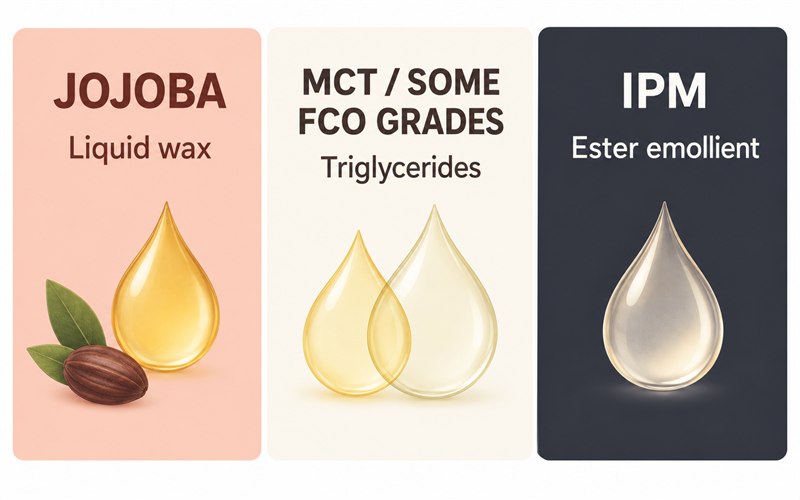
Ask for the ingredient name, chain composition, raw-material source and relevant quality specification. If two suppliers offer the same material family, compare their actual grades and documents. A coconut-origin requirement should be stated explicitly rather than inferred from an MCT label.
IPM is an ester option for a spreading brief
IPM stands for isopropyl myristate. Chemical supplier Sigma-Aldrich describes its chemistry as an ester made from isopropyl alcohol and myristic acid. It belongs to the carrier discussion because of its formulation role; it is different from a botanical oil simply extracted from a seed.
Cosmetic ingredient manufacturer Croda describes Crodamol IPM as a low-viscosity emollient with good spreading properties. That supplier description gives you a reason to include it in a sample brief aimed at easier spreading. The proportion used and the surrounding formula still need evaluation.
Try the finished sample for the feel you want: movement on application, visible film and residue at the point you would normally touch clothing or another surface. Use a cosmetic grade with suitable documentation. An ester name alone cannot establish that the whole perfume will suit a particular person’s skin.
Stability evidence needs the same scope as the conclusion
In a 2022 peer-reviewed study in BPB Reports, pharmaceutical-science researchers at Osaka University compared crude jojoba oils of different origins and production histories with deodorized and refined oils. They found variation in oxidative stability and antioxidant activity among the crude oils, with little correlation between the two measures.
The useful implication is to buy a specified grade and track the material you evaluated. An antioxidant claim and an oxidative-stability result answer different questions. The study’s raw-oil tests also cannot determine the shelf life or fragrance longevity of your finished perfume, and they do not establish a winner among jojoba, MCT and IPM.
Request relevant quality and storage information with the sample. Review the complete perfume in its intended package, including changes in smell, colour and appearance. If a carrier grade or supplier changes, compare the replacement against the approved sample instead of assuming the ingredient name settles equivalence.
Compare the finished perfume before choosing the carrier
A useful trial has two stages: examine each carrier alone, then examine the fragrance in that carrier. This helps separate a base odour or colour from a change associated with the whole blend. Keep the fragrance identity, proposed load and application method consistent across the comparison.
- Base odour. Smell the carrier sample on its own and ask whether it fits the intended scent direction.
- Fragrance fit. Record clarity, visible sediment and the scent as it develops in the complete sample.
- Skin feel. After suitability review, compare spreading and residue under the intended use conditions.
- Package performance. Check the actual roller or dispenser for delivery, leakage and compatibility.
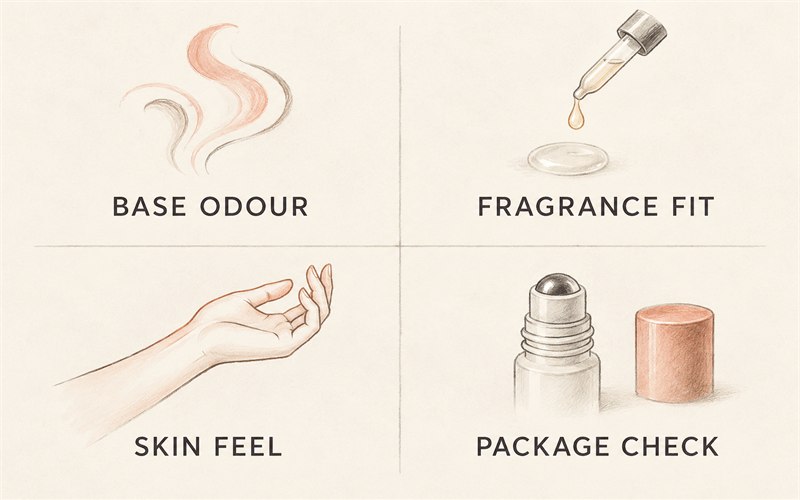
These are proposed selection checks, with acceptance conditions to agree for the product. Skin suitability and market requirements need a separate finished-formula review. The US Food and Drug Administration (FDA), the US cosmetic regulator, sets out manufacturers’ and marketers’ safety responsibilities in its fragrance guidance. Neither a natural-origin description nor a pleasant carrier feel provides that assessment.
If your intended format is a spray, add the alcohol and dispensing questions from our guide to mixing perfume oil with alcohol. A carrier selected for a roll-on should not be assumed to work unchanged in that format.
Questions that can change your shortlist
Should I choose cold-pressed jojoba for better performance?
Choose the processing grade that fits the brief and sample result. The raw-oil study shows that oxidative stability and antioxidant activity are different measures, so neither cold-pressed nor refined is a complete performance verdict. Compare the odour, colour and complete fragrance sample you will actually purchase.
Can I blend carriers instead of choosing just one?
You can ask a formulator to evaluate a blend when the brief calls for more than one property. Record the exact composition and repeat the relevant sample and package checks. Combining two appealing carrier descriptions does not establish that the mixture will remain compatible with your fragrance or deliver the intended feel.
Which carrier makes perfume last longest?
The cited material information does not establish a longest-lasting winner for finished perfumes. Use the same fragrance, application conditions and evaluation plan when comparing samples. Keep fragrance longevity separate from raw-oil oxidation resistance; a material can store well without demonstrating a longer scent on your skin.
Put the carrier decision into the sample brief
Start with the intended format and the property you most want to improve. For a quiet base, shortlist a suitable MCT or caprylic/capric triglyceride grade. For a botanical liquid-wax concept, evaluate the relevant jojoba grade. For a spreading brief, include an appropriate IPM grade or a proposed blend. Keep alternatives until the finished sample answers the brief.
A discussion with a fragrance supplier or development partner should include carrier specifications, scent direction, application, target markets and packaging. Scentake approaches development through these briefs, sample decisions and supply-chain information. Share the perfume-oil format and carrier properties you want to compare so the next step is an agreed sample project with the necessary documents before an order.