
Are Masking Agents Fragrance? How Brands Hide Odors Without Creating Scent

An unscented lotion can have a carefully managed smell. Its base may contain oils or other ingredients with an odour of their own, and the finished product may smell quiet because the formula includes something that changes what reaches your nose.
Masking agents can be fragrance, even when they leave no noticeable perfume. The broader term odour-control ingredient also covers materials that capture or bind suitable odour molecules. To work out which approach a brand uses, ask what was added and what it does. The absence of a floral, citrus or woody scent cannot answer that question.
When masking means adding fragrance
The US Food and Drug Administration (FDA), which regulates cosmetics in the United States, explains in its fragrance guidance that some unscented products contain fragrance added to cover the unpleasant smell of other ingredients. The amount can be sufficient for that job without giving the product a noticeable scent.
That distinction is useful at the bathroom shelf. You may experience a cream as practically odourless while fragrance ingredients remain in contact with your skin. Describing the formula as unscented tells you about its apparent smell; it leaves the composition question open.
A brand might want a quieter base for several reasons, including a product brief that asks for little noticeable smell. You do not need to assume deception to ask for clarification. “Does the formula contain fragrance used only to mask the base?” is a more precise question than “Does it smell of perfume?”
Three different routes to a quieter-smelling product
Odour control can involve changing the smell you perceive, acting on the molecules responsible for an odour, or revisiting the ingredients and process that produce it. Those routes deserve separate questions during product development.
| Approach | What changes | What to ask |
|---|---|---|
| Masking fragrance | The perceived smell of the mixture. | Which fragrance ingredients are added, and how is the claim supported? |
| Capture or binding | The availability of suitable odour molecules. | Which odours and product conditions has the material been evaluated for? |
| Reducing the source | A raw material, processing choice or other source of the base smell. | Can the base be improved while retaining its intended performance? |
Chemical ingredient manufacturer WACKER explains in its cyclodextrin technical information that suitable molecules can fit inside a cyclodextrin’s cavity. Size and chemical compatibility matter. The document discusses food applications, so it illustrates inclusion chemistry rather than proving that a particular lotion will become odourless.
Speciality ingredient manufacturer Evonik describes another route in its odour-control portfolio: zinc-ricinoleate systems that bind selected malodours. This is a supplier’s explanation of its technology. Ask for application evidence in the product you are developing before treating it as a solution for your base.
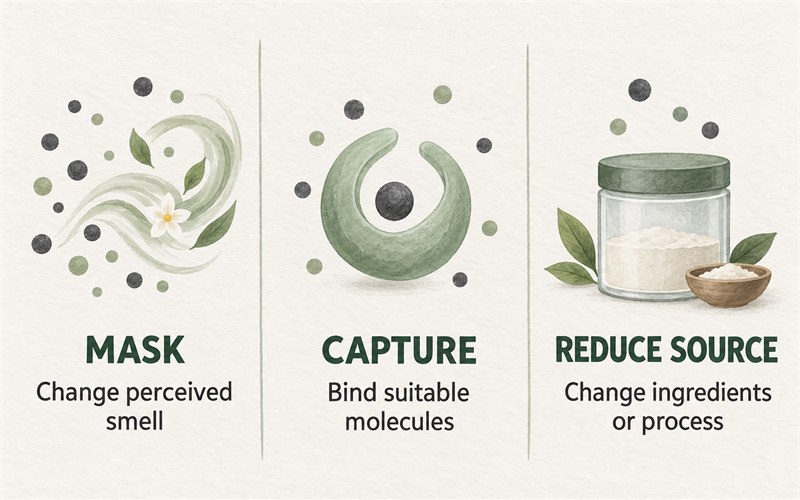
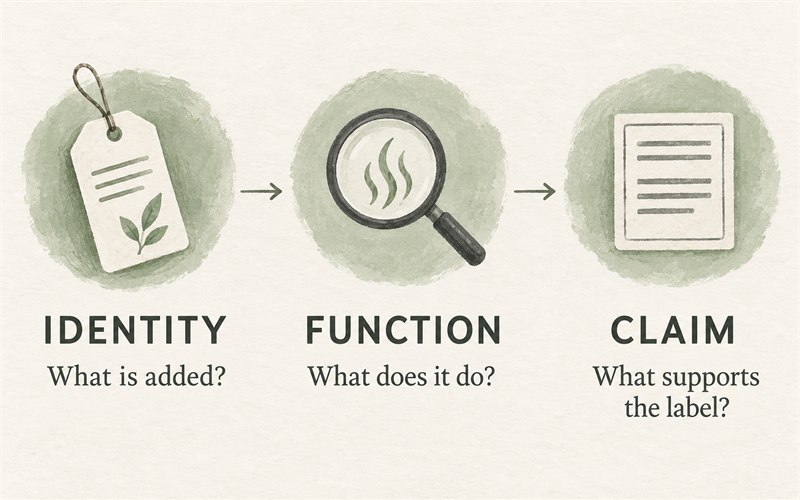
For buyers, the practical distinction is the job being done. A material used to capture an odour and a fragrance used to cover it should not be treated as interchangeable. A formula can also combine approaches. Keep the ingredient identity, intended function and observed result together in the sample record.
What the ingredient label can reveal
The FDA’s Cosmetics Labeling Guide specifically discusses masking agents that cover an off-odour without adding a discernible smell. It says they may be declared by their individual names or as fragrance. A label therefore does not need a separate entry literally called masking agent for this function to be present.
The guide also mentions an incidental-ingredient exception. Read that alongside the current US ingredient rule: the exception concerns insignificant levels with no technical or functional effect in the finished cosmetic. A low dose alone is insufficient. A brand should have a sound basis for any exemption it relies on.
For a shopper, the list is a starting point rather than a complete map of ingredient functions. If avoiding added fragrance matters to you, ask the manufacturer about masking fragrance as well as perfume. If you have a diagnosed ingredient allergy, ask about that specific substance and follow the avoidance advice you have been given.
A fragrance-free claim needs its own explanation
In its guidance on cosmetic wipes, the FDA says fragrance-free cosmetics should contain no added fragrance ingredients. Other ingredients may still contribute a smell. A faint base odour therefore does not by itself disprove the claim, just as little noticeable smell does not prove the absence of fragrance. Our comparison of fragrance-free and unscented products explains the difference when shopping.
Certification has a separate scope. The US Environmental Protection Agency (EPA), the federal environmental regulator, offers an additional fragrance-free certification for eligible Safer Choice and DfE products. Its current programme standard requires review for fragrance materials, including chemicals with a dual fragrance function. This programme criterion should not be assumed to govern every ordinary cosmetic label.
For people with atopic dermatitis, the American Academy of Dermatology (AAD), a US professional association of dermatologists, recommends fragrance-free skincare in its eczema care guidance because fragrance can trigger flares. An odour-control claim gives no individual assurance of tolerance. Consider the complete formula and your known triggers when choosing a product.
Turn an odour-control brief into a useful sample request
Start by defining the outcome: less base smell, no noticeable added perfume, or a substantiated fragrance-free claim. Those are different acceptance criteria. Writing “make it neutral” leaves too much room for different interpretations.
- Describe the base and use. Identify the product category, intended application and selling markets. Record which smell needs attention and when it appears.
- Ask about the proposed material. Request its identity, carrier, intended function and relevant application information. Separate a technical explanation from an actual test in your base.
- Compare samples with a control. Evaluate the unchanged base alongside the proposed version under the same conditions. Record smell, appearance and other product properties that matter to the brief.
- Review the claim separately. Retain the full ingredient information and the reasoning behind the wording on the label. A quieter sample alone cannot substantiate every claim.
This is a proposed screening approach, with acceptance conditions to agree for the product. It can help organise the discussion with a fragrance supplier or development partner. Scentake approaches such projects through the product brief, samples and supply-chain information. Share the base, target markets and intended odour-control claim so the next discussion addresses the actual formulation decision.
Questions worth asking before changing products
Does a tiny amount stop a masking fragrance from being fragrance?
The quantity and the ingredient’s function are different questions. Fragrance used to mask a smell remains added fragrance even when you barely notice it. For US ingredient disclosure, the narrow incidental exception also requires no technical or functional effect in the finished cosmetic; simply describing a dose as tiny does not settle it.
Can the same ingredient have more than one function?
Yes, and that can matter when assessing a claim. Ask what the material does in the actual formulation rather than relying on one name in a supplier catalogue. A programme such as EPA’s fragrance-free certification considers dual fragrance functions, so its review may be broader than a brief that excludes only an added perfume blend.
What if a product develops a new unpleasant smell?
A changed smell deserves investigation of the product and its storage history. Covering it with another fragrance does not explain why the change occurred. Keep the packaging and batch information and ask the manufacturer for guidance; for development samples, investigate the base before treating stronger odour masking as the next adjustment.