
Can Fragrance Oils Be Applied Directly to Skin? Dilution, Safety and IFRA Categories
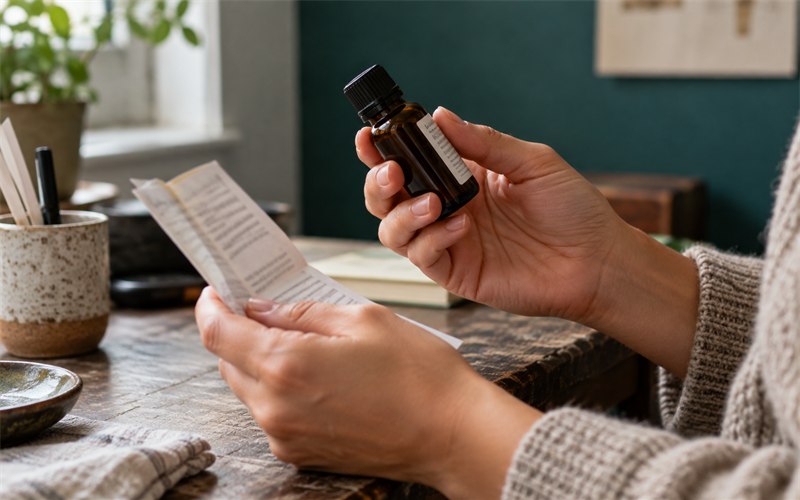
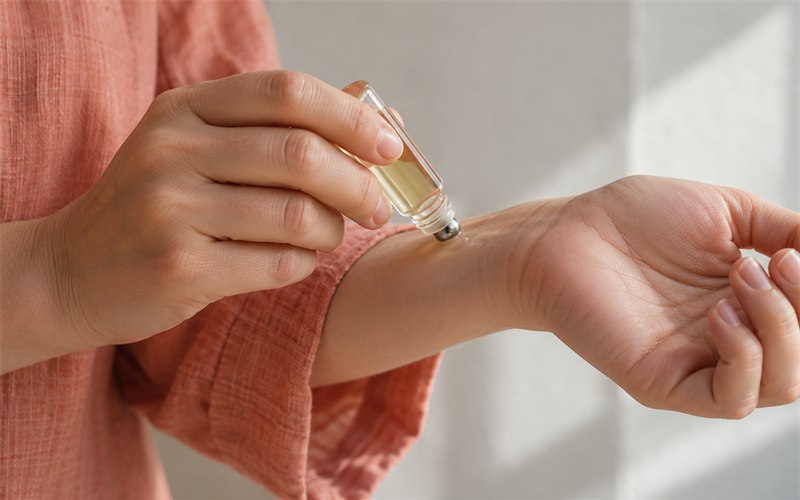
A bottle labelled fragrance oil may be a perfume you can wear, or a concentrated ingredient intended for further formulation. The name, the colour and the presence of a rollerball do little to settle that question.
A finished perfume oil intended for skin can be applied according to its directions. A fragrance concentrate should not be applied neat, and an unidentified oil needs clarification before skin use. Start with the product’s intended use, then check the formula and any dilution instructions. There is no single percentage that makes every fragrance oil suitable for skin.
Identify what is actually in the bottle
Look for a clear description of the product as a ready-to-wear skin perfume, together with an ingredient list and application directions. A label saying “for candles,” “for formulation” or “fragrance concentrate” points to a different job. “Skin-safe” on a supplier page can mean suitable for incorporation into certain products at specified levels.
Fragrance materials supplier Fragrance2U, for example, explicitly advises against applying its oils undiluted in its product-use guidance. That instruction concerns the supplier’s concentrated materials. It should not be extended to every finished oil perfume sold by another brand.
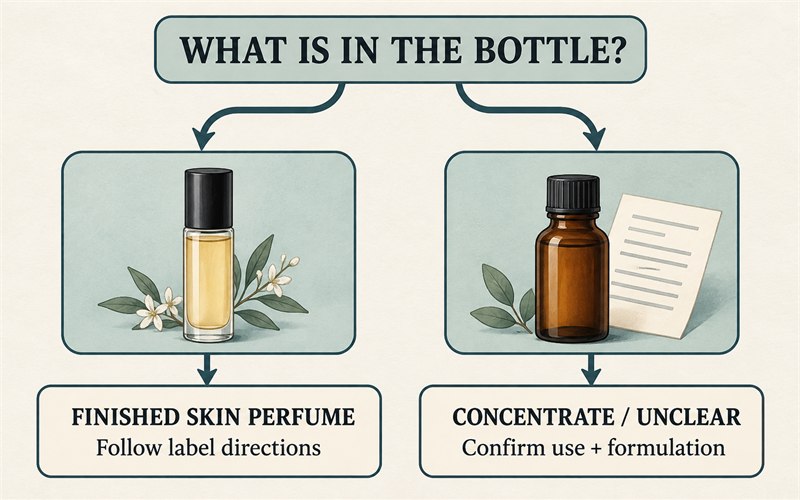
If the listing is ambiguous, ask a precise question: “Is this a finished cosmetic intended for direct skin application, or an ingredient requiring formulation?” Ask for written directions for that exact product. Until the answer is clear, smelling it on a blotter tells you more safely about the scent than experimenting on your wrist.
Why dilution depends on the finished product
Dilution changes how much fragrance mixture is present in the product you apply. It does not identify an unknown mixture or establish its suitability for the intended exposure. The carrier, the fragrance composition and whether the product stays on the skin all belong in the formulation decision.
US candle and fragrance materials supplier CandleScience distinguishes a maximum use level from a recommended amount in its soap and lotion guidance. A permitted ceiling leaves the maker to choose an appropriate working level and assess the complete product. Transferring a soap percentage to a leave-on perfume skips that assessment.
The International Fragrance Association (IFRA), the fragrance industry’s standards association, explains that ingredient restrictions concern the complete finished product. For a purchased fragrance mixture, use the supplier’s corresponding mixture certificate and confirm what its percentage represents. Weigh the fragrance and the final batch so that your calculation uses the same basis.
- Assume, purely for arithmetic, that the supplier documents a 2% maximum for one particular mixture and intended use.
- For a 100 g finished batch, 2% would equal 2 g of that mixture within the total 100 g.
- The remaining 98 g would contain the base and every other ingredient. This hypothetical ceiling is not a recommended dilution or evidence that the example formula is safe.
If you are choosing a base, compare the actual grades in our guide to carrier oils for perfume oil. A pleasant skin feel is useful during development; it cannot replace checking the fragrance’s allowed use.
Match the IFRA category to the way you use it
IFRA’s 51st Amendment guidance separates uses that can sound similar on a shop page. The following examples help you identify which application to discuss with the supplier.
| Intended product | Category | What to check |
|---|---|---|
| Fine fragrance, including oil-based perfume | 4 | Whether the formula is intended as fine fragrance. |
| Body oil, cream or lotion | 5A | The body-care application and its corresponding limit. |
| Bar soap | 9 | The rinse-off application; do not borrow its limit for perfume. |
| Candle | 12 | The candle application; it provides no permission for skin use. |
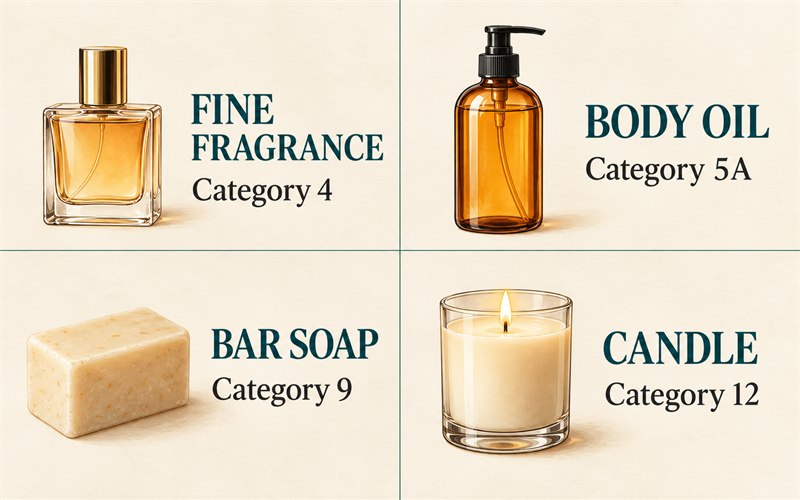
A small perfume roll-on and a fragranced body oil can therefore need different category checks. Describe how and where the finished product will be used instead of asking only whether the oil is “cosmetic grade.” Confirm the relevant amendment and category when obtaining the current certificate.
Read the certificate alongside the rest of the formula
According to IFRA’s certificate guidance, the fragrance mixture supplier issues the certificate; IFRA itself does not. The document addresses conformity for specified intended uses. It also does not replace a safety assessment of the finished product, and the industry standards do not remove applicable legal obligations.
- Match the certificate’s product name or code to the fragrance you are buying.
- Confirm that the document covers the supplied formula version and relevant amendment.
- Find the intended-use category and ask whether its percentage refers to the mixture as supplied.
- Compare that maximum with your proposed formula and any more restrictive supplier instructions.
- Request the supporting handling and allergen information needed for the product and sales market.
The US Food and Drug Administration (FDA), the federal regulator responsible for cosmetics in the United States, places safety and proper labelling responsibility on cosmetic manufacturers and marketers. For a buyer, the useful question is whether the complete skin product has been addressed. A certificate for one ingredient cannot answer every question about the bottle you plan to sell.
What to do before wearing or ordering an oil
For a finished skin perfume, follow its application directions and warnings. The American Academy of Dermatology (AAD), a professional medical association, recommends trying finished skin-care products on a small area before broader use. That guidance is not permission to test an undiluted concentrate on yourself. If a product causes a reaction, gently wash it off and stop using it; seek medical advice for a severe or persistent reaction.
For a sourcing project, prepare a short brief naming the finished product, application area, carrier, fragrance level, target market and intended claims. Ask which documents cover the exact proposed sample. Keep the sample code with its formula and document versions so you can compare a revised submission without confusing the two.
If you are developing an oil perfume with Scentake, send the intended use and sample brief as the starting point for a discussion. State whether you need a finished skin fragrance or a concentrate for further formulation. That distinction makes the next questions about documentation, samples and supply much more productive.
Common questions about skin use
Can I use a candle fragrance oil as perfume?
A candle-use claim alone gives you no basis for doing so. Ask whether that exact fragrance is also intended for the proposed skin product, and obtain its corresponding formulation guidance and certificate. Adding carrier oil to a candle-only or unidentified product does not supply the missing information.
Does natural fragrance need less checking?
No. FDA’s guidance on natural aromatic ingredients explains that plant-derived materials can irritate skin or cause allergic reactions. Choose a product by its composition, intended use and directions. “Natural” or “organic” cannot tell you a suitable dilution.
Will changing the carrier or adding alcohol solve the problem?
A different base changes the formulation questions. It does not establish the identity or permitted use of the fragrance. If you want to turn an oil into a spray, first check the carrier and alcohol compatibility, then evaluate the proposed finished product and its documentation.
Does a successful home patch test prove an oil is safe?
No. A small-area trial cannot establish a concentrate’s safe use level or guarantee future tolerance. AAD describes medical patch testing as a dermatologist-supervised investigation of possible contact allergens. If you have a known fragrance allergy or recurring reactions, ask your dermatologist about suitable products rather than testing an unknown oil.