

How to Choose Perfume for Sensitive Noses Without Giving Up Scent

Start with the trigger, not the perfume family
For someone with a sensitive nose, choosing perfume can feel like a trade between personality and comfort. A bright citrus that feels cheerful in a shop may become sharp in a warm car. A soft musk may be pleasant on a blotter, then feel heavy after an hour. The useful question is not simply which note is “gentle.” It is which exposure, format, concentration, and wearing routine lets you enjoy scent without inviting the reaction you already know too well.
Sensitive noses are not all sensitive in the same way. One person notices headache or nausea from strong diffusion. Another develops itching or a rash after a product touches skin. Asthma, allergic rhinitis, migraine, damaged skin barriers, and a previously diagnosed contact allergy can all change the sensible approach. A perfume recommendation cannot diagnose the cause. It can, however, make the next choice more deliberate.
Key takeaway: You do not need to give up scent because your nose is sensitive. Choose a lower-exposure format, test one product at a time, and treat “hypoallergenic,” “natural,” and “clean” as prompts to inspect the formula rather than guarantees of comfort.
The U.S. Food and Drug Administration notes that fragrance ingredients may be declared collectively as “Fragrance” on consumer cosmetic labels, and that some people can be allergic or sensitive to components that are safe for most users. Its fragrance guidance is a helpful reminder to read the whole label, then ask the manufacturer for clarification when your history requires more detail.
Know which kind of sensitivity you are managing
The word “sensitive” is convenient, though it can hide important differences. Scent overload is mainly about airborne intensity. It may show up as discomfort, a headache, queasiness, coughing, or a feeling that the perfume will not leave the room. Skin reactions are different. They may involve irritation or allergic contact dermatitis after direct exposure. If you have wheezing, facial swelling, hives, trouble breathing, or a severe reaction, stop using the product and seek medical care promptly.
For recurring skin reactions, a clinician or dermatologist can help distinguish irritation from allergy and may recommend patch testing. The FDA’s cosmetics-allergen overview explains that patch testing is commonly used to investigate dermatitis. A diagnosed allergen gives you a far better shopping filter than a broad promise on the front of a bottle.
| What you notice | Practical starting point | What to avoid assuming |
|---|---|---|
| Overwhelm from strong smell | Test low-projection formats and shorter wear time | That a floral or natural scent will automatically be lighter |
| Itching, rash, or burning after contact | Pause use, review ingredients, seek clinical advice for repeat reactions | That “for sensitive skin” proves every ingredient suits you |
| Known asthma or allergy history | Discuss individual triggers with a healthcare professional and avoid untested exposure | That a small bottle makes a fragrance low-risk |

Choose the delivery format before chasing a note
The same scent direction can behave very differently as an alcohol spray, an oil, a solid perfume, a body lotion, or a home product. Sprays create an immediate airborne cloud. That can be enjoyable for a wearer who likes diffusion, yet it gives a sensitive nose the least gradual starting point. A dabbed oil or solid perfume may let you control the amount more closely, although direct skin contact still matters if you are prone to dermatitis.
For sensory sensitivity, start with a sample, one light application, and a place you can leave easily. Spray into the air around you is often less controlled than putting a small amount on a blotter first. For skin sensitivity, do not treat a casual wrist try as a substitute for medical patch testing. Follow the brand’s directions and use professional advice when there is a known allergy.
A useful rule is to reduce the number of variables. Try one fragrance on a calm day, without a newly scented body wash, laundry product, or room diffuser competing in the background. Write down the format, amount, weather, and time until discomfort appears. Patterns become visible much faster when the test is simple.
Look for a quieter scent structure
There is no universal list of “safe notes.” Materials, dose, formula architecture, and personal history all matter. Still, many sensitive wearers find it easier to evaluate fragrances that stay close to the skin and develop with fewer dramatic peaks. A restrained tea, rice, soft-wood, clean-musk, or watery-floral idea may feel easier to live with than a large sweet amber, a loud white floral, or a sharp aromatic opening. That is a starting hypothesis, not a medical claim.
Ask whether the brand describes projection, longevity, and concentration plainly. A formula designed for a powerful trail can be beautiful, though it may not suit a person whose main issue is airborne intensity. A lighter structure may need more frequent, smaller reapplication. This is often more comfortable than one large spray that persists after you wish it would fade.
Common misconception: Natural, organic, or essential-oil-based perfume is not automatically easier for a sensitive nose. Natural aromatic materials can contain constituents that matter for allergy, irritation, or fragrance intensity.
The FDA similarly advises consumers not to assume that “hypoallergenic,” “natural,” or “organic” claims determine safety for an individual. In the United States, “hypoallergenic” has no federal definition. FDA guidance on hypoallergenic cosmetics makes the point clearly. A transparent ingredient list and a manufacturer willing to answer focused questions are usually more useful than a reassuring front-label adjective.
Read labels with a realistic expectation
Ingredient labels are valuable, though they do not always reveal every component of a proprietary fragrance mixture. In the United States, “Fragrance” or “Flavor” can appear as a collective declaration. In the EU, certain fragrance allergens require individual labelling under defined conditions, while the rules and transition periods differ by market. The European Commission’s fragrance-allergen page provides the regulatory context.
Use the label as a conversation starter. If you have a diagnosed trigger, ask the brand whether it can confirm the relevant ingredient or provide an allergen declaration for the intended market. If the response is vague, do not force a guess. A different product with better documentation may be the better purchase.
- Check whether your concern is airborne intensity, direct skin contact, or both.
- Keep photos of labels and batch information if you have reacted before.
- Ask for a full ingredient list, allergen information, or a product-specific response where applicable.
- Be cautious with “unscented” products, which may still use a small amount of fragrance to mask a base odour.
Build a low-pressure testing routine
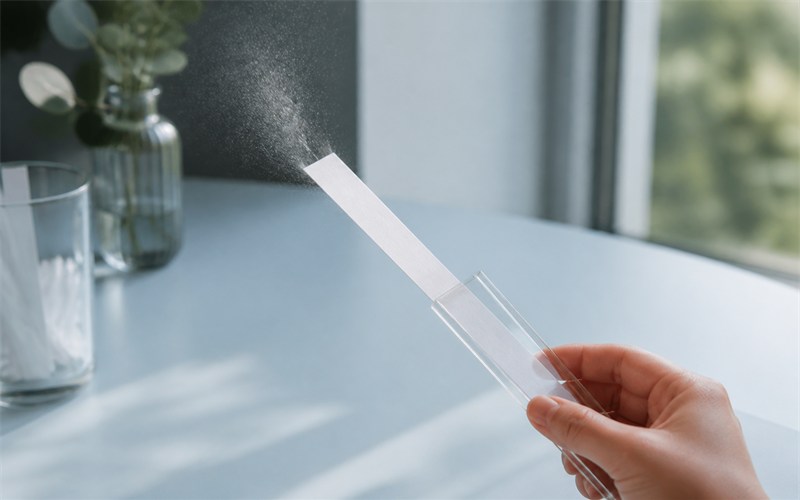
A good test is slow enough to reveal the drydown. Smell the blotter briefly, step away, then return after 15 to 30 minutes. If it remains comfortable, move to a very small, directed skin trial only when that is appropriate for you. Avoid testing several perfumes on the same outing. Nose fatigue can turn every result into noise.
Test in an ordinary setting, not only in a heavily scented store. Temperature, ventilation, exercise, stress, and other scented products all change your experience. For airborne sensitivity, a window seat or outdoor walk often gives more useful information than a crowded counter. For a suspected allergic response, stop self-experimenting after a reaction and seek medical guidance.

What fragrance brands can do for sensitive consumers
For brands, sensitivity is a design brief rather than a single marketing claim. Start with the intended user, application method, target market, exposure pattern, and desired scent footprint. Then assess the complete fragrance formula in the finished product base. A perfume oil, alcohol spray, shampoo, and body lotion each create different exposure conditions and stability questions.
Clear communication matters as much as fragrance development. Avoid promising that a product is “allergy-proof.” Explain the format, expected scent intensity, ingredient disclosure route, and any testing or compliance documents that genuinely apply. Scentake’s fragrance-formula guide outlines why performance comes from the complete composition, not a single headline material.
For fragrance buyers: bring a defined brief. Include the product base, target market, desired level of projection, known excluded materials, consumer profile, cost range, and supporting documents you need. This helps a development team create a scent direction that is both emotionally appealing and practical to assess.
Questions people often ask
Is fragrance-free always the best choice for a sensitive nose?
For someone with a diagnosed fragrance allergy or strong reactions to scented products, fragrance-free products can be a sensible starting point. For sensory sensitivity alone, the right choice can depend on intensity, ventilation, dose, and personal triggers. A healthcare professional can help when symptoms are recurring or severe.
Can I rely on a perfume labeled hypoallergenic?
No label can guarantee that a product will suit every person. In the U.S., the term has no federal definition. Treat it as a reason to check what the brand means, inspect available ingredients, and test cautiously rather than as a blanket assurance.
Are essential-oil perfumes better for sensitive people?
They can still contain constituents that are relevant to a particular allergy or sensitivity. Natural origin does not predict comfort. Compare the full product information, use a controlled test, and consult a clinician if you have a known reaction history.
What should I do after a reaction?
Stop using the product. Seek urgent medical attention for breathing difficulty, faintness, or swelling. For less urgent but recurring skin or respiratory symptoms, contact a healthcare professional and keep the product, label, batch details, and a note of when symptoms started. In the U.S., suspected cosmetic adverse events can also be reported to the FDA.
Keep scent, change the way you choose it
A sensitive nose calls for more control, not a joyless routine. Start smaller. Favour clear information. Give the drydown time. If a fragrance repeatedly makes you uncomfortable, believe that result and move on. For brands developing a lower-intensity or more transparent fragrance concept, contact Scentake with your product base, target market, scent direction, and documentation needs.