
Why Does a Perfume Label Say “Fragrance” Instead of Listing Every Ingredient?
One Word Can Represent a Complex Mixture
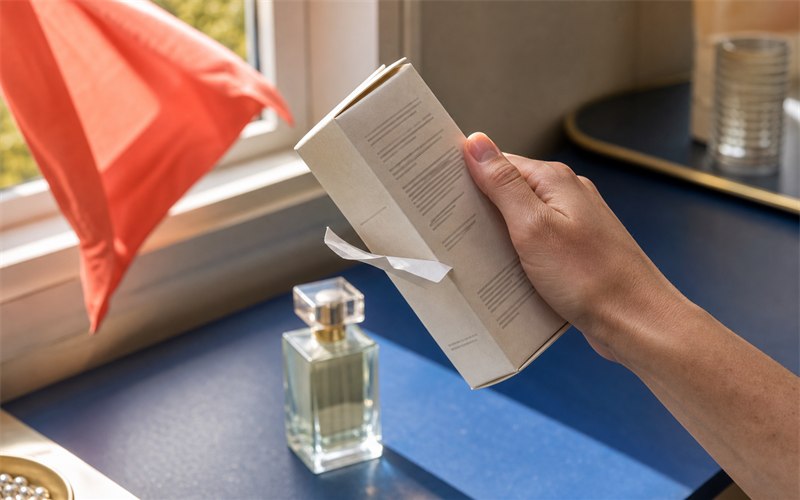
Turn over a perfume box and the ingredient line may name alcohol, water, colorants, and then a single word: “Fragrance.” That compact entry can represent a composed scent mixture containing numerous odor materials and supporting ingredients. The label is using a collective declaration permitted by the rules of the market, rather than claiming that the bottle contains only one aromatic substance.
Core answer: in the United States, a cosmetic fragrance compound may be declared as “Fragrance” under 21 CFR 701.3. The term groups the materials used to create the scent while protecting commercially sensitive formula details. It does not remove the manufacturer’s responsibility for product safety, accurate labeling, or disclosures required by another market.
What “Fragrance” Means on a U.S. Cosmetic Label
The FDA requires most retail cosmetics to carry an ingredient declaration. Ingredients generally appear by common or usual names in descending order of predominance, subject to specific rules. Fragrance compounds have their own declaration option.
The FDA Cosmetics Labeling Guide states that fragrance and flavor compounds may be declared as “fragrance” and “flavor.” Their components may also be declared individually using appropriate label names. A brand therefore can provide more formula detail, yet the collective term remains an expressly permitted route for the scent compound.
| Label entry | What it communicates | What it does not prove |
|---|---|---|
| Alcohol, water, colorant, or another named ingredient | An individually declared part of the cosmetic formula | Its exact percentage unless another rule requires it |
| “Fragrance” | A fragrance compound used for scent or, in some cases, masking | Every component, origin, concentration, or allergen profile |
| A separately named fragrance allergen | That a market-specific disclosure condition has been met | That the ingredient is unsafe for every user |

Why the Scent Formula Is Grouped
A perfume accord is a system. Natural extracts, aroma chemicals, diluents, antioxidants, and other functional materials can work together to control odor, diffusion, stability, and handling.
Formula confidentiality also matters. Competitors can learn valuable information from the identity and balance of materials that create a recognizable signature. The FDA explains that the U.S. fragrance declaration reflects the Fair Packaging and Labeling Act’s treatment of commercially sensitive fragrance composition. The specific allowance should not be confused with a blanket right to hide unrelated formula ingredients.
What the Label Still Has to Tell You
A collective “Fragrance” entry does not erase the rest of the package. U.S. label rules cover product identity, net quantity, the responsible company’s details, the ingredient declaration, and required warnings or directions. A cosmetic that is also an over-the-counter drug has additional obligations.
Fragrance ingredients meet the same legal safety requirement as other cosmetic ingredients. The FDA does not preapprove ordinary cosmetic formulas, so the companies that manufacture or market them remain responsible. The collective name is a disclosure format, not an FDA safety seal.
Consumer boundary: the word “Fragrance” cannot tell you whether a perfume is natural, synthetic, allergen-free, stronger, safer, or better made. Those questions require other evidence, such as a market-compliant ingredient panel, safety substantiation, supplier documents, and the finished product’s intended use.
Why the Same Perfume Can Have Different Market Labels
U.S. cosmetic labels commonly use “Fragrance.” In the European Union, perfume and aromatic compositions are generally referred to as “parfum” or “aroma” in the ingredient list. EU rules also require certain fragrance allergens to be named individually when their concentration exceeds defined thresholds. A global pack may show parallel naming to serve several destinations, provided each market’s requirements are satisfied.
Commission Regulation (EU) 2023/1545 added individual labeling requirements for 56 additional fragrance allergens at 0.001% in leave-on products and 0.01% in rinse-off products. It also established transition periods. Brands need to check the applicable dates and current Annex III entries for each launch.

Fragrance Mixture and Fragrance Allergens Are Different Ideas
“Fragrance” names the mixture collectively. A fragrance allergen is a substance that can trigger allergic contact dermatitis in a sensitized person. An allergen can be part of a fragrance mixture, while the collective term alone does not identify its components.
A named allergen on a label is information for avoidance and market compliance. It does not mean every consumer will react, and its absence from a U.S. panel cannot establish that the perfume contains none. FDA advises people concerned about fragrance sensitivity to examine ingredient information carefully and contact the manufacturer when they need more detail.
Claims such as “fragrance-free,” “unscented,” or “hypoallergenic” need careful reading. FDA notes that U.S. federal law does not govern some of these terms as shoppers may assume. An unscented product can use masking fragrance, so the complete ingredient context matters.
What Consumers Can Do When They Need More Detail
- Read the complete ingredient panel and confirm that it belongs to the exact product, size, and market you intend to buy.
- If you know the name of a fragrance allergen you avoid, look for it individually and ask the responsible company whether the current formula contains it.
- When contacting a brand, provide the product name, batch or lot code, purchase market, and a clear question instead of requesting the full proprietary formula.
- Keep the carton or a photograph of the label if a reaction occurs, stop using the product, and seek appropriate medical advice for persistent or serious symptoms.
- For a new perfume, follow the product directions and avoid assuming that a short ingredient list predicts personal tolerance.
A useful request is specific: “Does this batch contain limonene or linalool, and can you share the current ingredient list for Thailand?” A request for every percentage reaches into proprietary composition and is less likely to be answered.
What Brands and Buyers Should Keep in the Technical File
Public labeling and internal disclosure serve different purposes. A brand may publish a collective fragrance term while its safety assessor, regulatory reviewer, or responsible person receives fuller supplier information under confidentiality. Buyers should define which records are required before approving artwork or production.
| Record | Decision it supports | Control point |
|---|---|---|
| Fragrance specification and code | Identity and traceability | Match every sample, order, and formula revision |
| Allergen declaration or compositional statement | Destination-market ingredient review | Use the current formula and threshold rules |
| IFRA Certificate of Conformity | Intended product category and maximum use level | Match fragrance, Amendment, end use, and dosage |
| Safety Data Sheet | Workplace handling, storage, and transport information | Keep the current supplier revision |
| Finished-product safety assessment and label review | Complete formula, exposure, claims, and legal release | Approve for each market and final product format |
Artwork control should link the ingredient panel to a formula version, allergen statement, market, and approval date. A fragrance change can alter label content even when the product name stays the same.
Frequently Asked Questions
Does “Fragrance” always mean synthetic ingredients?
No. A fragrance compound can contain natural extracts, synthetic aroma chemicals, or both. The collective term does not disclose the origin of every component.
Can a brand list every fragrance component voluntarily?
Yes. U.S. FDA guidance says fragrance components may be declared individually by their appropriate label names. Voluntary detail still needs to follow applicable labeling rules and the current formula.
Is “Parfum” the same as “Fragrance”?
Both can name a perfume composition collectively, although accepted nomenclature depends on the market. FDA says “Parfum” may follow the required U.S. common name in parentheses, but does not replace it.
Why can named allergens appear after the fragrance term?
Some markets require specified allergens to be declared above defined concentrations even when the perfume composition is listed collectively. This supplies avoidance information without publishing the complete formula.
Does an IFRA certificate provide the ingredient list for the label?
No. It documents conformity for stated product categories and use levels. Label preparation also needs allergen or compositional information, the finished formula, market rules, and qualified review.
Build Transparency Around the Real Decision
Consumers usually need to know whether a product contains a substance they avoid. Brands need enough supplier information to assess safety, build a lawful ingredient panel, and control changes. Neither goal requires a careless public release of every formula ratio. Useful transparency gives the right person the right level of detail, tied to the exact product and market.
Scentake’s guides to fragrance formulas, common fragrance allergens, and the difference between natural and synthetic fragrance materials can help teams prepare a clearer brief. For a commercial perfume or consumer-fragrance project, share the target market, product format, intended dosage, claims, and documentation needs with Scentake. That information helps align fragrance development with label review from the start.