
What Does “Natural Fragrance” Mean on a Product Label?
A Front-Label Phrase Is the Beginning of the Definition
Natural fragrance appears on perfume, skincare, soap, home fragrance, and cleaning-product packaging. It can signal that the scent is made from plant, mineral, microbial, or naturally derived inputs under a framework. The two words do not reveal the formula, percentage, processing rules, certification, allergens, or performance.
Core answer: natural fragrance is usually a sourcing and formulation claim defined by a brand, supplier, standard, certification program, or market convention. Its meaning can vary. Read the nearby qualifier, ingredient list, certification mark, website definition, and supporting documents together. Natural origin does not automatically establish purity, safety, sustainability, organic status, or freedom from allergens.
A useful label makes the claim verifiable. A stated natural-origin percentage or named certification provides more information than a standalone leaf icon.
In the United States, FDA Has Not Defined Natural for Cosmetic Labels
The FDA’s small-business cosmetics fact sheet states that the agency has not established a regulatory definition of natural for cosmetic labeling. Cosmetic claims still need to be truthful and not misleading, and the same safety and labeling requirements apply regardless of ingredient source.
Companies may use a defensible internal or third-party framework. They should state what is counted, which processing is allowed, how the result is calculated, and whether the claim covers the fragrance concentrate or the finished product.
Do not read natural fragrance as FDA-approved, automatically organic, allergen-free, non-toxic, or suitable for every user. A source claim and a safety conclusion answer different questions.

The Ingredient List and the Marketing Claim Do Different Jobs
On a U.S. retail cosmetic, fragrance ingredients can generally be declared collectively as Fragrance rather than listing the proprietary formula. The FDA explains that fragrance formulas may contain natural and synthetic ingredients and are often protected as trade secrets. A front-panel natural-fragrance claim can describe sourcing, while the ingredient declaration follows its own naming rules.
Fragrance in the ingredient list does not prove that the blend is synthetic, while natural fragrance on the front does not reveal every constituent. Allergen disclosure and voluntary transparency can add information.
| Label element | What it can tell you | What it cannot settle alone |
|---|---|---|
| Natural fragrance claim | Chosen sourcing or formulation position | Exact formula, safety or certification |
| Fragrance in ingredients | A fragrance mixture is present | Natural-origin percentage |
| Named essential oils | Some botanical ingredients are disclosed | The composition of the entire scent |
| Certification mark | A named program may have criteria | Compliance outside that program |
| Allergen declaration | Listed substances above applicable thresholds | Personal tolerance for every user |
Industry Frameworks Can Define the Claim, Yet They Are Not Identical
The IFRA Natural Complex Substance Task Force published a 2025 position explaining that the fragrance industry has no single official global definition of natural. Its supported approach references aromatic raw materials that meet selected ISO terms and definitions, while emphasizing that the consumer-product manufacturer remains responsible for product description and promotion.
ISO 16128-1 provides technical definitions and criteria for natural and organic cosmetic ingredients. ISO also states that this standard does not address product claims and labeling, human safety, environmental safety, fair trade, packaging, or regulatory requirements. A calculation framework is useful, although it does not answer every consumer question.
Processing Determines Which Natural Categories a Material Fits
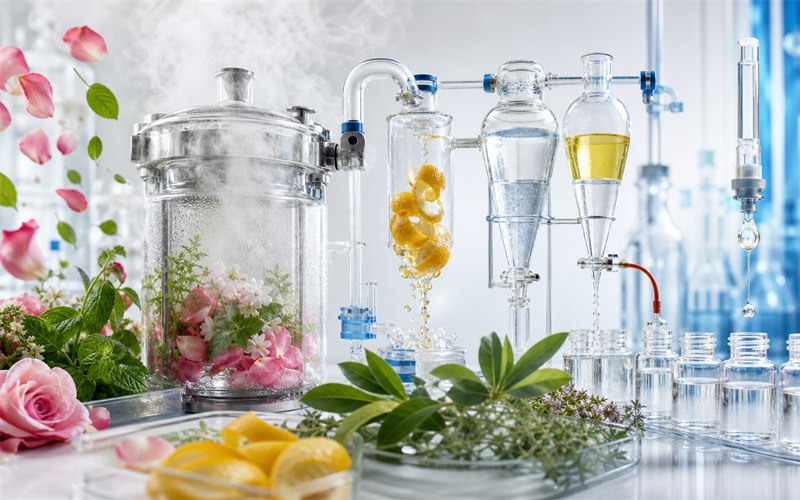
A botanical name does not describe the whole manufacturing route. Steam distillation, expression, extraction, fermentation, fractionation, purification, hydrolysis, and other transformations can produce materials with different status under different frameworks. An essential oil is a complex extract. A natural isolate is a separated molecule. A naturally derived material may involve permitted chemical transformation.
These distinctions affect odor and formulation. Fractionation can remove color, waxes, or selected constituents. Isolation can provide tighter consistency, and fermentation can create aromatics from renewable feedstocks. The claim should match the processing rules actually used.
Natural Fragrance Is Not the Same as Essential Oil, Organic or Safer
Essential oil describes a type of volatile botanical extract. Natural fragrance usually describes a blend or claim framework and may include essential oils, absolutes, extracts, natural isolates, and other permitted materials. A product scented only with essential oils can make a narrower statement if that is accurate, while another natural fragrance may use a broader palette.
Organic relates to agricultural production and certification criteria. A natural material is not automatically organic, and an organic cosmetic still has to meet applicable cosmetic safety and labeling rules. The FDA notes that ingredient source does not determine safety.
Natural aromatic materials can contain sensitizing, irritating, restricted, or phototoxic constituents. Safety depends on composition, concentration, product category, exposure, and user population. The essential oils versus fragrance oils comparison explains why both routes need documentation and finished-product testing.
| Term | Practical meaning | Evidence to look for |
|---|---|---|
| Natural fragrance | A scent claim under a defined framework | Definition, scope, percentage and supplier statement |
| Essential oil | A complex volatile botanical extract | Botanical identity, extraction method and specification |
| Natural origin | A calculation that may include derived categories | Method, denominator and result |
| Organic | Certification tied to agricultural rules | Certifier, scope and valid certificate |
| Fragrance free | No added fragrance ingredients under the claim used | Full formula review and market-specific guidance |
What Brands and Buyers Should Request Before Using the Claim
- Name the target market, product category, claim wording, certification goal, and launch date.
- Define natural, naturally derived, natural origin, and excluded materials in writing.
- Specify whether the claim covers the fragrance concentrate, all aromatic materials, or the complete finished product.
- Request supplier declarations, formula-revision control, ingredient specifications, SDS, allergen information, and applicable IFRA documentation.
- Document the calculation method, numerator, denominator, water treatment, carrier treatment, and rounding rules.
- Review the final package, website, advertising, translations, and retailer copy for consistent wording.
- Reconfirm the claim whenever the fragrance, supplier, processing route, formula, standard, or market changes.
The file should let a qualified reviewer reproduce the conclusion. Name the framework, version, scope, supplier evidence, and fragrance formula revision.
How Consumers Can Read the Label More Critically
Start with the exact wording. Made with natural fragrance can describe the presence of some natural fragrance without stating that every aromatic material is natural. 100 percent natural fragrance is a stronger claim, yet it still benefits from a published definition. Natural scent and botanical aroma may be marketing language with another scope.
Then check the ingredient list, certification, allergen information, warnings, manufacturer contact, and any linked definition. Ask whether the claim applies only to the scent or to the whole product. Consumers with sensitivities should use guidance relevant to their needs rather than natural as a safety shortcut.
Frequently Asked Questions
Does natural fragrance mean the formula contains no synthetic materials?
It may mean that under the brand’s framework, although the label should make the scope clear. The rest of the finished product can still contain materials outside the fragrance claim. Ask for the definition and whether carriers or processing aids are included.
Does natural fragrance mean essential oils only?
Usually no. Depending on the framework, it may include essential oils, absolutes, extracts, natural isolates, and other permitted aromatic materials. Essential-oil-only is a more specific claim.
Is natural fragrance better for sensitive skin?
The phrase alone cannot establish that. Natural fragrance can contain allergens or irritants, and individual sensitivity varies. Review the complete product, directions, warnings, and relevant professional advice.
Can a fragrance be partly natural?
Yes. A formula can combine natural and other aroma materials, and some frameworks calculate a natural-origin percentage. The label should avoid implying a higher scope than the evidence supports.
A Credible Claim Has a Visible Evidence Trail
Natural fragrance is meaningful when the brand defines the term, identifies the scope, controls revisions, and keeps evidence current.
Scentake can help translate a scent brief, natural-positioning goal, product base, market, and cost target into a documented fragrance route. Review the fragrance-formula guide and common fragrance allergens, then contact Scentake with the exact claim you want to support. The strongest label promise is one that formulation, documentation, and finished-product testing can all defend.